I get the same question in different clothes. Someone has about $500 left in the budget, a system that already plays music, and a shortlist that somehow starts with a DAC, a cable, or a power conditioner.
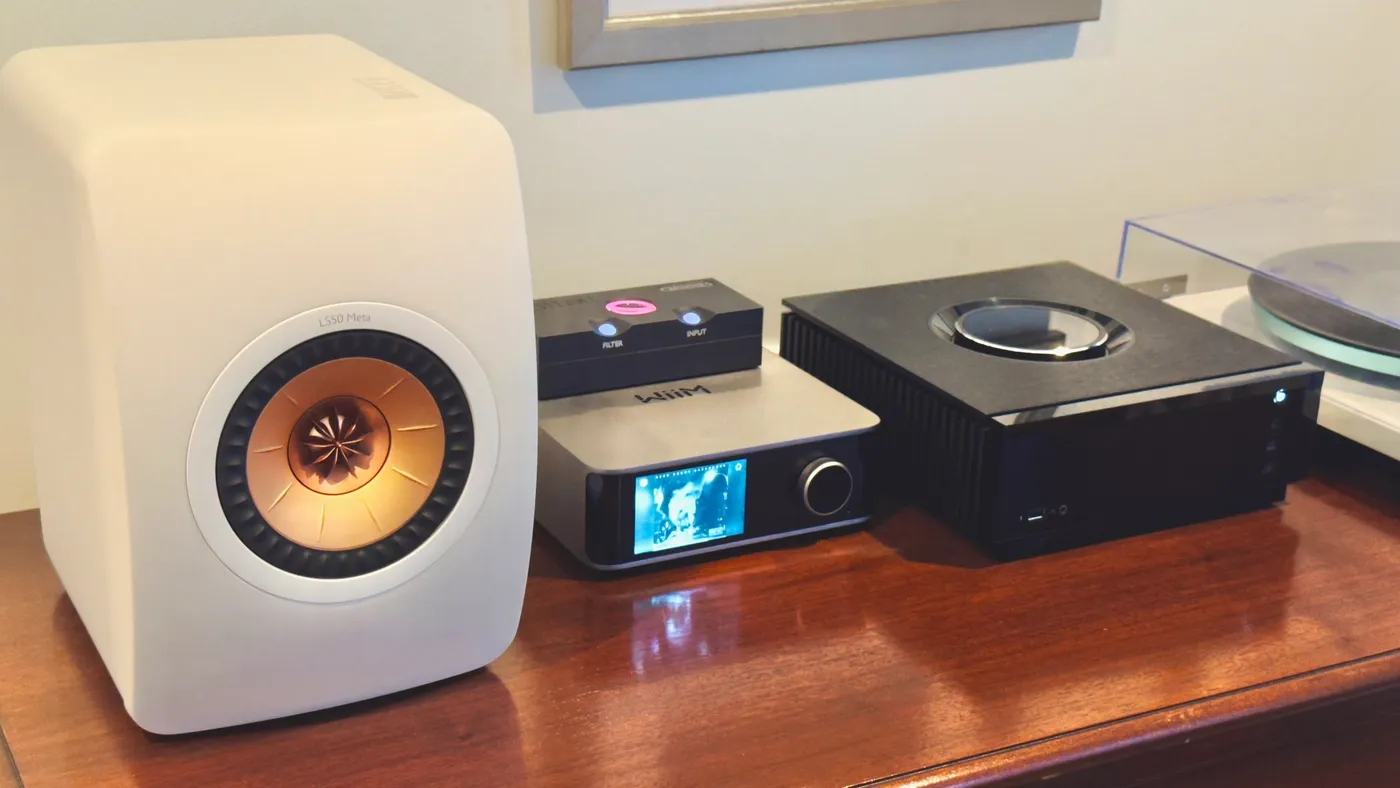
I have lived that shortlist. I own a WiiM Ultra, a Chord Qutest, a Chord Mojo 2, a Naim Uniti Atom, KEF LS50 Metas, and a miniDSP UMIK-1. Those are heard. Everything else in this piece is research or a view, labeled that way. I am not inventing listening reports for boxes I have not sat with.
This is not a “best DAC under $500” page. For that rabbit hole, start with Best DACs in 2026 and keep the honesty labels. This page ranks where the dollar moves the system, scored against gear and rooms I actually know.
The ranking I use
Weight goes in this order:
- Speakers
- Placement and room / room correction
- Amplification and speaker-to-room match
- DAC, then cables, isolation, and power
That order is boring on purpose. Forums sell the opposite story because small boxes are easy to buy and easy to argue about. Speakers and rooms are harder to photograph and harder to return in one click. They are still where most of the sound lives.
If your stack is already sorted and you just want a second opinion aimed at your gear, use the gear advisor. It asks about the room and the bottleneck, not just the next shiny chassis.
Speakers still win the loudest fights
If the speakers are the weak link, $500 on anything else is theater. A better pair in the same room will usually outrun a better converter, a nicer interconnect, or a quieter power strip. That is not mysticism. It is the transducer and the air in front of it.
I run KEFs (heard). The LS50 Meta taught me how much the box and the room decide before the streamer even boots. When people ask me whether to “upgrade the DAC first,” my first question is whether the speakers are already the ones they plan to keep.
Research note, not a listening claim: if you are still on mass-market Bluetooth cylinders or tiny computer speakers, read Your speakers are lying to you before you shop digital accessories. The $500 conversation changes once real stereo speakers are in the chain.
Placement is the free upgrade
Before you spend a cent, move the speakers and the chair.
Pull them off the wall. Give them some breathing room. Toe them in until the center image stops wandering. Sit where the left and right lock together. Re-check after every move with the same two or three tracks you know cold.
I keep saying this because I keep watching people buy gear to fix a null. You cannot EQ a cancellation out of existence. Dirac Live alternatives covers that limit with sources; the short version is move first, measure second, buy third. Placement costs an afternoon and a tape measure. It also tells you whether your next $500 should be a mic, an amp, or nothing at all.
When $500 on room correction beats $500 on electronics
In a typical untreated living room, the room is louder than the DAC chip.
A UMIK-1 (heard) is about $79 on miniDSP’s sheet. Pair it with free REW, or with software you already own, and you can see the peaks that make bass boom in one chair and disappear in the next. That is the highest-leverage $500-or-less path I know when the electronics are already competent.
On the WiiM Ultra (heard), RoomFit is already in the box. I have used it in this room. It is not Dirac. It does not pretend to be. It still cleaned up the low end enough that I stopped blaming the streamer for problems the walls owned. For the wider map of phone apps, Audyssey, Dirac, and the rest, see the room correction guide and Audyssey vs Dirac Live (not heard on those AVR stacks; research only).
So here is the $500 rule I would print on a sticky note:
- Electronics already fine, room still messy: buy measurement and correction, not another converter.
- Room already measured and speakers already placed: then look at amp headroom or a speaker change.
- You already love a DAC’s sound and you want to keep it across streamer swaps: that is the case for spending on a dedicated converter, and it is a preference case, not a rescue mission.
Amplification and speaker match
Amps matter when they are the bottleneck. They matter less when they are already driving the speakers cleanly at the levels you actually use.
The Naim Uniti Atom (heard) is a 40 W all-in-one that still sounds like itself years later. It is also honest about limits. Ask it to wrestle inefficient floorstanders at party levels and you will feel the ceiling. Pair it with sensible speakers in a normal room and the argument shifts from watts to taste.
If your speakers are KEF Metas or something in that demand neighborhood, start with best amp for KEF LS50 Meta and the first-hand Chord Anni with LS50 Meta notes before you throw $500 at a DAC. Matching the amp to the load beats stacking another digital box in front of an amp that is already gasping.
Research/not-heard on brands I have not lived with: I will not invent a wattage shootout. If the amp clips, gets hot, or runs out of control at your normal volume, that is your $500 problem. If it does not, keep walking down the list.
When a dedicated DAC beats the WiiM Ultra’s DAC (and when it does not)
I bypass the Ultra’s DAC. My chain is Ultra into Qutest (heard), then into the amp and the Metas. I wrote the full setup in WiiM Ultra external DAC.
That does not mean the Ultra’s ESS converter is bad. Measurements from Audio Science Review and SoundStage put it among competent modern DACs, and I said as much in that piece. Blind comparisons on ASR described external-DAC differences as subtle. John Darko called the Ultra tonally a bit grey. My own note from the Ultra review was slightly warm yet detailed. Those descriptions do not line up cleanly, which is the tell: the gap is small and system-dependent.
So when does a Qutest or Mojo 2 (heard) beat the Ultra’s built-in DAC in a way that justifies money?
It can make sense when:
- You already want that DAC’s character and plan to keep the converter while streamers rotate.
- You need headphone drive or a form factor the Ultra does not give you (Mojo 2’s job more than Qutest’s).
- You have already fixed placement and the obvious room problems, and a careful home A/B still leaves you preferring the external box.
It usually does not make sense when:
- The room still owns the bass.
- The speakers are next on the replacement list.
- You are buying a DAC to “fix” an Ultra that already measures well and has never failed a sanity check in your room.
I have never run a lab-grade, level-matched Ultra-vs-Qutest shootout in this room, so I will not pretend I have a decibel for you. I kept the Qutest because I like living with it. That is the honest sentence.
For Chord-only shopping, Qutest vs Mojo 2 and Best Chord DACs stay first-hand where I lived with the boxes.
Cables, isolation, and power come last
I am not saying these categories are fake. I am saying they are last for a $500 decision when speakers, seat, room, and amp match are unfinished.
Research/not-heard on boutique cables and power conditioners I have not A/B’d as a program: buy competent, well-made interconnects and power cords that fit and stay plugged in. Spend the rest of the $500 where the system still has a measurable or obvious problem. If your hobby joy is cable rolling, own that as hobby joy. Do not confuse it with the highest-leverage fix.
A cheap adjacent experiment I have heard is the SMSL PO100 PRO DDC in my Ultra-to-Qutest path. That was about USB hygiene into a DAC I already loved, not a substitute for speakers or room work. Different job, different rung on the ladder.
Concrete $500 scenarios
WiiM Ultra plus passive bookshelves
Assume Ultra (heard) into a modest integrated, into decent passive bookshelves.
- Placement afternoon. Free.
- If bass is still a mess, UMIK-1 (heard) plus RoomFit or REW. Often well under $500 all-in.
- If the amp is the soft limit at your volume, put the money toward amp headroom or better speaker/amp match, not a DAC.
- External DAC only after the above, and only if a returnable home A/B still makes you care. See Ultra external DAC.
All-in-one like a Naim Uniti Atom
Assume Atom (heard) into efficient speakers.
- Placement first. The Atom will not save a sofa jammed against the wall.
- Measurement mic if you can insert correction somewhere useful in the chain, or treat the room mechanically (rugs, curtains, bookcases) before you hunt a separate DAC.
- Speakers that love 40 W beat a converter feeding speakers that do not.
- A separate DAC only helps if you have a real digital path reason, not because the Atom “needs” one on principle.
”I already own Ultra and Qutest”
That is my house. The next $500 is rarely another digital box. It is room work, a sub related decision, or living with the system long enough to hear what still bothers me on Tuesday night. The PO100 was a small, reversible digression. It did not rewrite the ranking above.
Buy it where you can bring it home and A/B
Whatever you pick, buy from a retailer with a real return window of 30 days or more when you can. Level-match as best you can. Swap only one thing. Listen to the same tracks at the same volume. Keep the box only if the difference survives the boring test.
Sighted forum confidence is cheap. A week at home is the actual review.
What I would tell a friend
Spend the first $500 on the problem you can point at without a brochure. Speakers that are wrong for the room. A seat in a null. Bass that fights the walls. An amp that runs out of steam. A DAC is a fine purchase when it is the thing you actually want. It is a poor purchase when it is a substitute for moving a speaker six inches.
If you want that logic applied to your exact stack instead of mine, run the gear advisor. And if you want the short version of these upgrade calls in your inbox every other week, the newsletter is where I keep saying the quiet part out loud: the room usually wins before the chip does.