The Best Chord DACs in 2026: Which One Is Right for You?
A Chord owner's guide to the whole DAC lineup in 2026, from the portable Mojo 2 to the flagship DAVE. What makes a Chord a Chord, current prices, and which one actually fits your system.
I have lived with Chord's Mojo 2 and Qutest. Everything else here is researched consensus, labeled that way, so you know what I have actually heard.
A DAC turns digital audio into the analog signal your headphones or amp can use. Phones, laptops, streamers, and many integrated amps already have one. Buying another only makes sense when it fixes a connection, output, control, or listening-habit problem you actually have.
I own and regularly use the Chord Mojo 2 and the Chord Qutest. Those sections below are first-hand. The other picks are researched from manufacturer specs, long-running buyer guides, and owner consensus. I have not auditioned every box on this page. For a Chord-only deep dive, start with Best Chord DACs in 2026.
This is a path guide, not a blind shootout. Start with how you listen, then pick a box that fits that path. Buying the functions your system lacks beats buying another “best DAC” badge.
| DAC | Role | Heard? | Standout | Skip if |
|---|---|---|---|---|
| Chord Mojo 2 | Portable DAC/amp | Yes | Battery + onboard tone controls | You need proper RCA/XLR line outs for a stereo rack |
| Chord Qutest | Pure desktop DAC | Yes | FPGA conversion, disappears in a system | You need a built-in headphone amp |
| RME ADI-2 DAC FS | Desktop DAC/amp + EQ | Research | Parametric EQ, Extreme Power + IEM jacks | You want pocket size or set-and-forget |
| Topping E30 II | Stereo line DAC | Research | USB/optical/coax to RCA | You need headphones from the same box |
| Cambridge DacMagic 200M | Mixed-source DAC/amp | Research | Bluetooth + wired dig + headphone out | You need a network streamer |
| Apple USB-C adapter | Minimal wired fix | Research | Tiny, bus-powered | You need inputs, EQ, or serious drive |
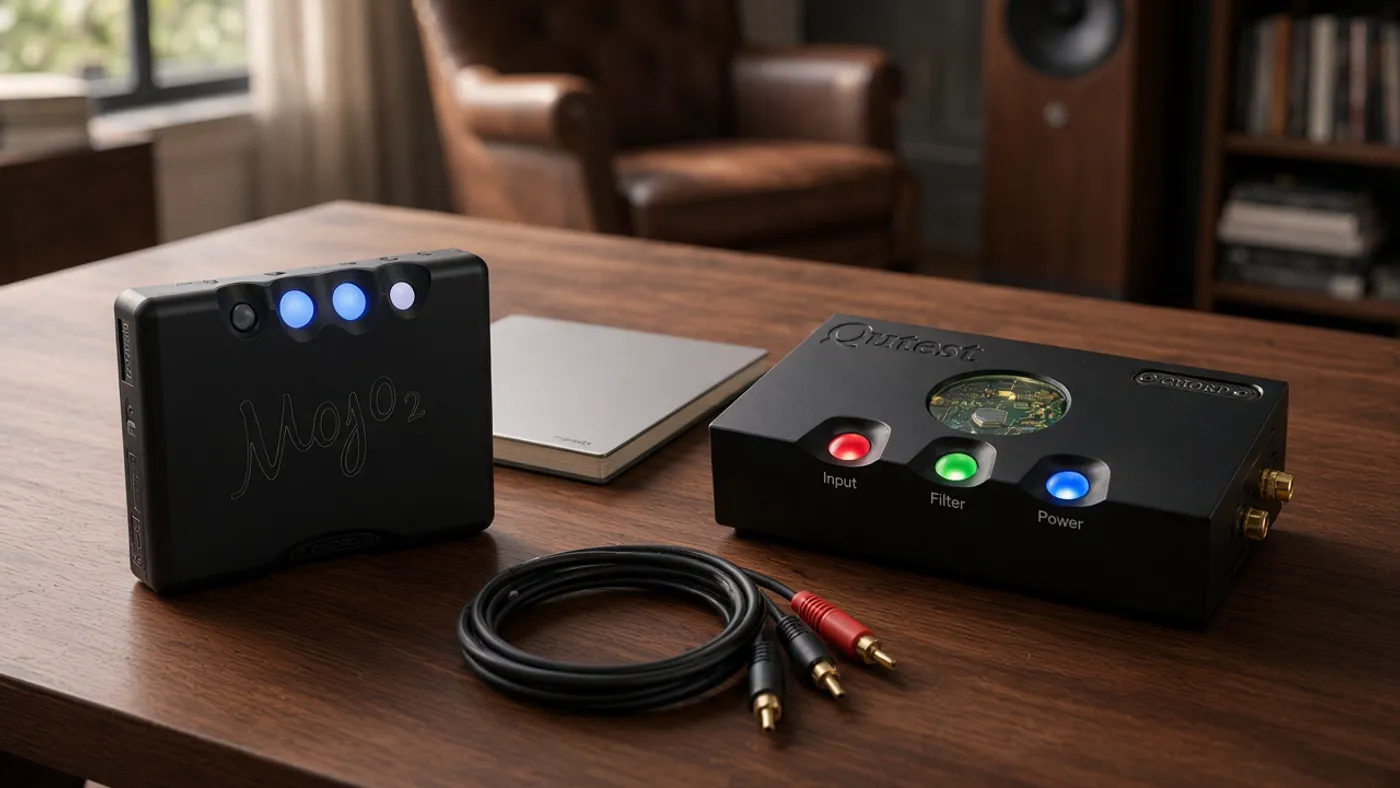
The Mojo 2 is a battery-powered DAC and headphone amp in one small brick. USB, optical, and coax in; dual headphone outs; Chord’s useful onboard tone controls. It is the cheapest way into the Chord house sound I actually recommend to friends, and it works at a desk as well as in a bag.
I have written it up in full in the Mojo 2 review and in Mojo vs Mojo 2. Short version for this guide: if your main habit is wired headphones and you want one box instead of a DAC plus a separate amp, start here around the mid-$600s street price Chord has settled into after recent cuts.
Pros (from use): conversion + amp in one; battery; several digital inputs; tone controls that are more useful than most gadget EQ.
Cons (from use): no conventional RCA/XLR for easy stereo integration, though the 3.5 mm jack can run as a line out if you need to feed an amp; the colored-sphere UI takes learning; you still charge it.
Buy if: headphones first, portable or desk-portable, Chord sound without a second box.
Skip if: your priority is feeding a stereo amp with proper line outs. Look at Qutest or a research line DAC instead.
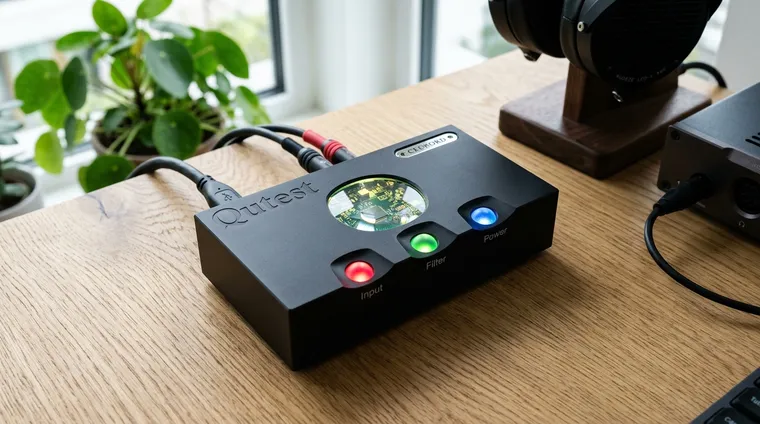
The Qutest is DAC-only: no headphone amp, no battery, no Bluetooth. Dual RCA out, selectable output voltage, four filters, same conversion family as higher Chord models. After living with it into a real system (and demoing before buying), it became my desktop endgame for speakers. That includes running it with the Chord Anni into KEF LS50 Metas, which is the first-hand desktop pairing I have actually swapped in and out of the rack.
Full story in the Qutest review. Versus Mojo 2 when you are torn: Qutest vs Mojo 2. Versus Hugo 2 when you want more features in one Chord: Hugo 2 vs Qutest.
Buy if: you already have (or will buy) an amp or powered speakers and want a transparent desktop DAC.
Skip if: you need headphones from the same chassis.
I have not owned this unit. Across buyer guides and owner forums it keeps showing up as the desktop box people buy when they want parametric EQ, a real display and remote workflow, and a fixed station that can drive headphones and speakers.
RME’s product page lists the I/O that actually matters: USB, coaxial S/PDIF, and optical S/PDIF in; RCA and XLR line out. The two headphone jacks are not twins. The 6.35 mm Extreme Power output is for demanding cans; the 3.5 mm Super Low Noise IEM jack is there so sensitive in-ears do not hiss. Street price in October 2026 sat about $1,000 to $1,300. Sweetwater listed it at $1,299.
That is a different job from Mojo 2. Mojo wins on battery and simplicity. RME wins when the desk is permanent and you will actually use the EQ and menus. Ignore sample-rate bragging; buy it for the controls.
The limitation that is not just “not portable”: the EQ and I/O flexibility live behind a deep display workflow. If you will never open those menus, you are paying for a control surface you will ignore.
Buy if (research): fixed desk, headphones and/or speakers, you want targeted EQ and I/O flexibility.
Skip if: you want pocket listening or a set-and-forget converter.
Research pick for “I already have an integrated amp; I just need USB, optical, or coax into RCA.”
The I/O is deliberately thin: USB-B, Toslink, and coaxial in; stereo RCA out at 2.1 Vrms. No headphone jack. No Ethernet. No Bluetooth. A remote can switch DAC (fixed) and PRE (variable) output; use fixed into an integrated’s line input unless you know why you want variable. Topping still lists the E30 II as a current model in October 2026. The cheaper E30 II Lite sibling (one AK4493S instead of two) shares the same jacks. There is no E30 III. Street price for the E30 II was about $130 to $150 in October 2026; Apos and Topping’s store listed $149.
The limitation that is not just “no headphones”: it is a 5V wall-wart converter with RCA only. It never becomes a headphone station, and it never browses a library. Leave it in PRE mode by accident and you have two volume knobs fighting.
Buy if (research): stereo amp already handles volume and power; you need a clean digital front end.
Skip if: headphones are the main load. That is Mojo, RME, Cambridge, or the Apple adapter territory.
USB, two optical, two coaxial, and Bluetooth aptX in; RCA, XLR, and a 1/4 inch headphone jack out. Cambridge’s US product page listed it at $399 in October 2026, and it is still the current DacMagic. What Hi-Fi was still treating it as a current desktop DAC in its April 2026 coverage.
Useful when several sources share one converter at home. It is not a network streamer: Bluetooth receive is not the same as browsing Spotify or Tidal on the box.
The limitation that is not just “not a streamer”: the headphone jack is a convenience output (Cambridge rates it above 300 mW into 32 ohms), not a serious desktop headphone station, and there is no Wi-Fi or app. If you want a library browser, that is a streamer conversation: WiiM Ultra, Eversolo DMP-A6 vs WiiM Ultra, WiiM Ultra vs Bluesound Node.
Buy if (research): desk or rack, mixed wired digital plus occasional Bluetooth, some headphone use.
Skip if: you need Wi-Fi streaming, apps, and a library browser.
Yes, it is a real DAC/amp in a dongle. The current SKU is Apple’s USB-C to 3.5 mm Headphone Jack Adapter (part MW2Q3AM/A), not the older Lightning dongle and not a third-party lookalike. USB-C in, 3.5 mm out, bus-powered, no other inputs. Apple’s US shop listed it at $9 in October 2026.
For a compatible phone or laptop and easy-to-drive wired headphones, solve the missing jack before you buy a desktop box. If it is quiet enough, clean enough, and loud enough for your cans, name a concrete reason before upgrading.
The limitation: it is bus-powered and input-less. Hard-to-drive headphones will run out of level, and there is nowhere to plug a CD player or streamer.
Buy if (research): you only need a basic wired path.
Skip if: you need input switching, physical EQ, or more power than a bus-powered adapter can give.
Matched listening levels matter when you compare. Louder often wins a fake shootout. A second box in the chain is also not automatically an upgrade; see Schiit Buf and Eitr 2 if you are tempted to insert another gadget before you have named the problem.
For the full Chord ladder (Hugo 2, TT2, DAVE, Poly, M Scaler), use Best Chord DACs in 2026. That page is the brand-depth companion to this decision guide.
A Chord owner's guide to the whole DAC lineup in 2026, from the portable Mojo 2 to the flagship DAVE. What makes a Chord a Chord, current prices, and which one actually fits your system.
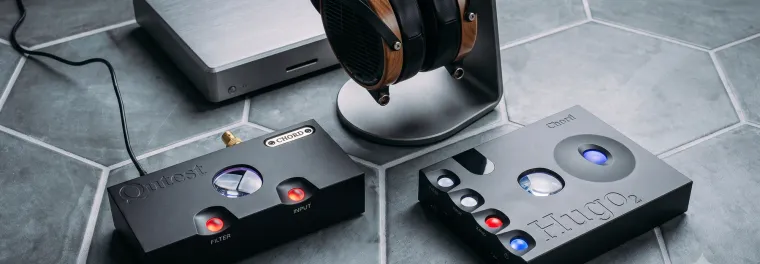
Hugo 2 or Qutest? They share the same 49,152-tap DAC core but solve different problems. Here's how to choose between Chord's portable all-rounder and its desktop specialist.
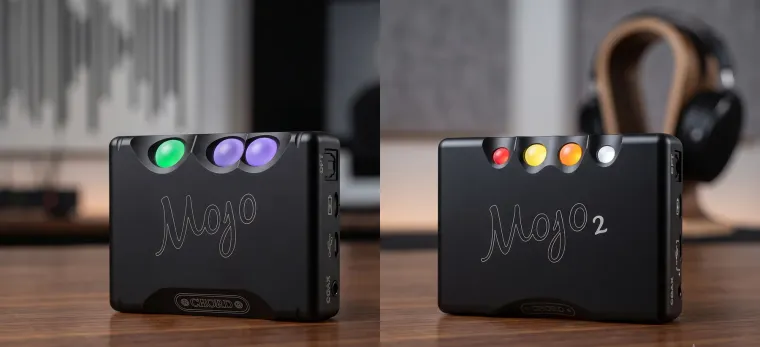
Is the Chord Mojo 2 worth it over the original Mojo? Here's what changed, the DSP EQ, the connectors, the battery, the sound, and whether the upgrade is worth it for you.