The KEF LS50 Meta is 85dB sensitive and dips to about 3.5 ohms in the bass. The Chord Anni is rated at 10 watts per channel. On paper that is not a system, it is a category error.
It is worth being clear about what the Anni is, because it is easy to set it up to fail. This is a desktop amplifier and a headphone amplifier first. Chord’s own description calls it a desktop integrated amp “capable of driving both headphones and compact loudspeakers,” positioned for “high-performance headphones, desktop monitors and high-resolution audio sources” (Chord Electronics). Read that carefully and you will notice the words doing the work: compact loudspeakers and desktop monitors. Chord never promised it would run a living room, and it is only fair to hold it to what it actually claims.
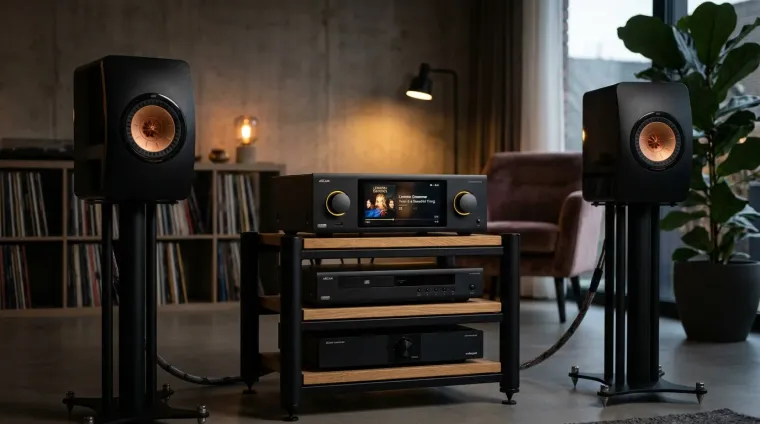
Except Chord itself keeps photographing it next to speakers that are not desktop monitors. In its own press imagery for the Qutest range, the Anni sits in a stack with the Qutest DAC and the Huei phono stage, alongside a KEF LS50 Meta. That framing was there from the launch, when the Anni was announced as a petite headphone and loudspeaker amplifier.
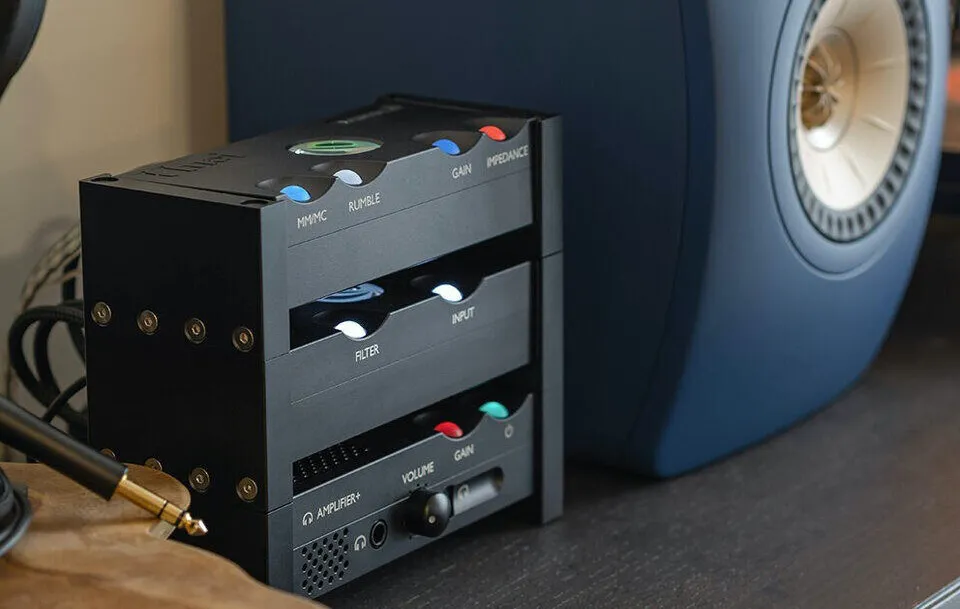
That is an odd photograph to publish unless somebody at Chord believed the pairing held up. And here is the strange part: almost nobody has written about actually running it. I went looking, and across forums, reviews and YouTube I found exactly one person who has done it and said so in print.
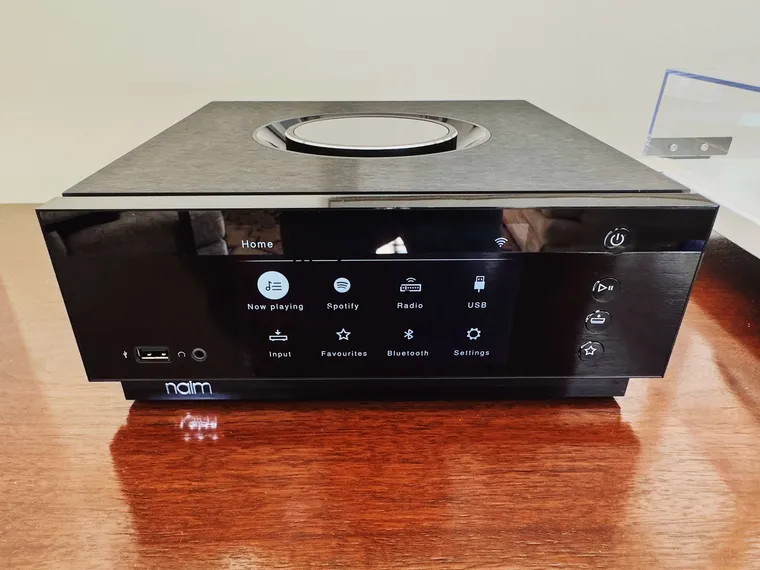
So I did the obvious thing. I pulled the Naim Uniti Atom out of my rack and put the Anni in its place, keeping everything else identical: WiiM Ultra as streamer and preamp, Chord Qutest as DAC, KEF KC62 sub, same room, same music.
It works. It also taught me more about what “enough power” actually means than any spec sheet has.
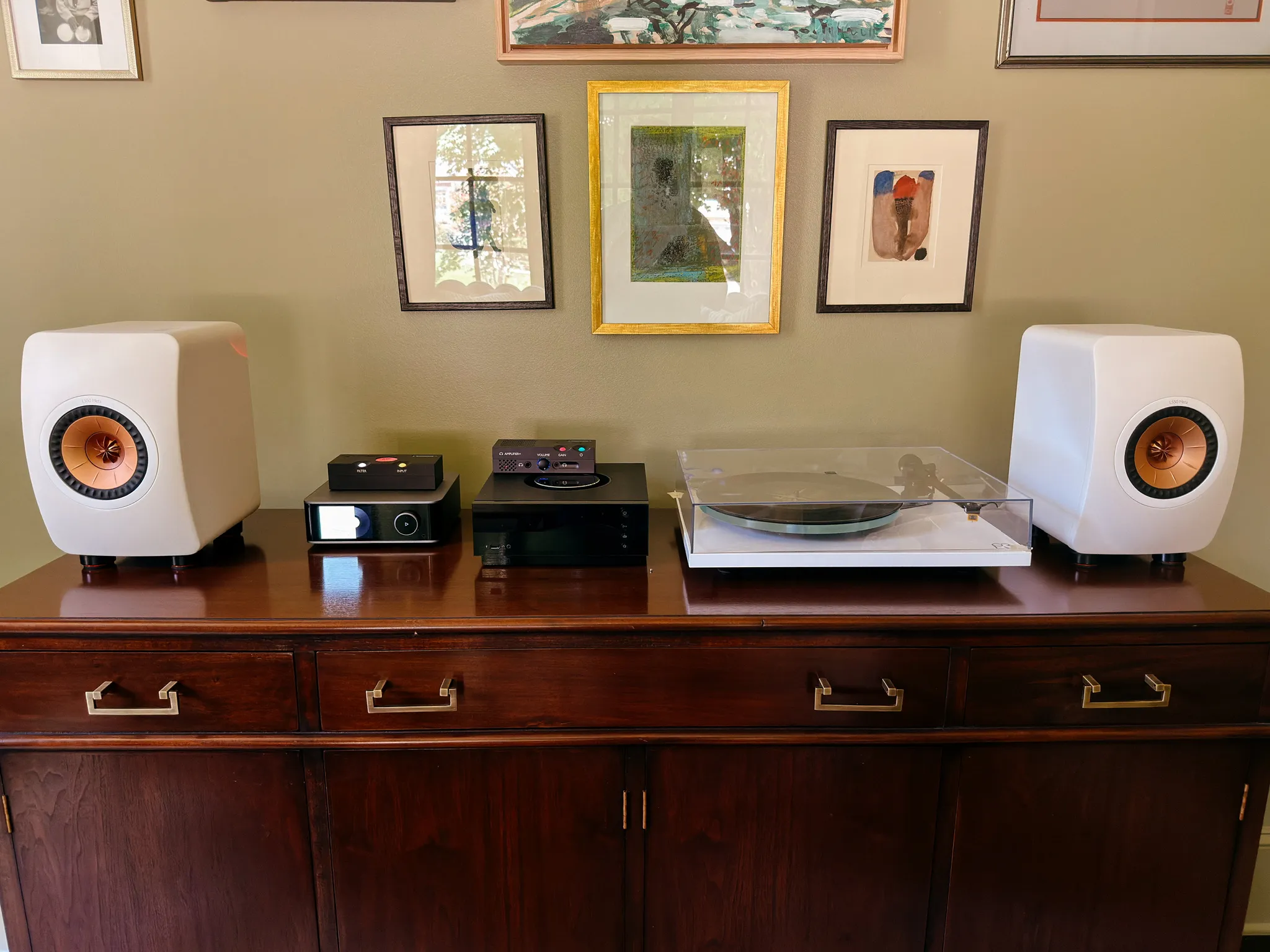
Yes, I know about the sideboard
Let me get ahead of the comments. My LS50 Metas sit on a sideboard, closer together than they should be, boundary-loaded against a wall, sharing a surface with a turntable. That breaks roughly every placement rule there is, and I am aware of all of them.
It is there because my wife would rather not live with two speaker stands in the middle of the room, and she is not wrong. This is the compromise almost every real system makes and almost no review admits to. Proper stands, more distance from the wall, and getting the turntable off the same plinth are all on my list, and when I make those changes I will write about what they actually bought me.
For this comparison it matters less than you might think, because the speakers never moved. Same position, same surface, same room, same sub setting, with only the amplifier changing. That makes it a fair test of the Anni against the Atom. It is not a claim about the best these speakers can sound, and I would not make one from this room.
The one other person who has tried it
For the record, since this turned out to be genuinely hard to find: Lieven at Headfonia ran the Anni on his own LS50 Metas, and he did it for the same reason I did, because Chord was promoting the setup in their press release.
His conclusion is worth quoting because it lines up with mine almost exactly. In low gain, he found the Metas “sound very light and forward,” missing body and impact. Switch to high gain and they “come to life with a full presence and powerful bass.” His verdict: a more powerful amp made them sound better, but he “could easily settle with the Anni and LS50 Meta combo” if he had to.
That is the whole review in two sentences, and it took a lot of searching to find. Everything below is my own listening, but I want to be clear that I am the second person to write this up, not the first.
The setup problem nobody warns you about
Before any of the listening was worth anything, I had to get the levels right. This is the part I would tell anyone considering this pairing, because getting it wrong will convince you the Anni is broken when it is not.
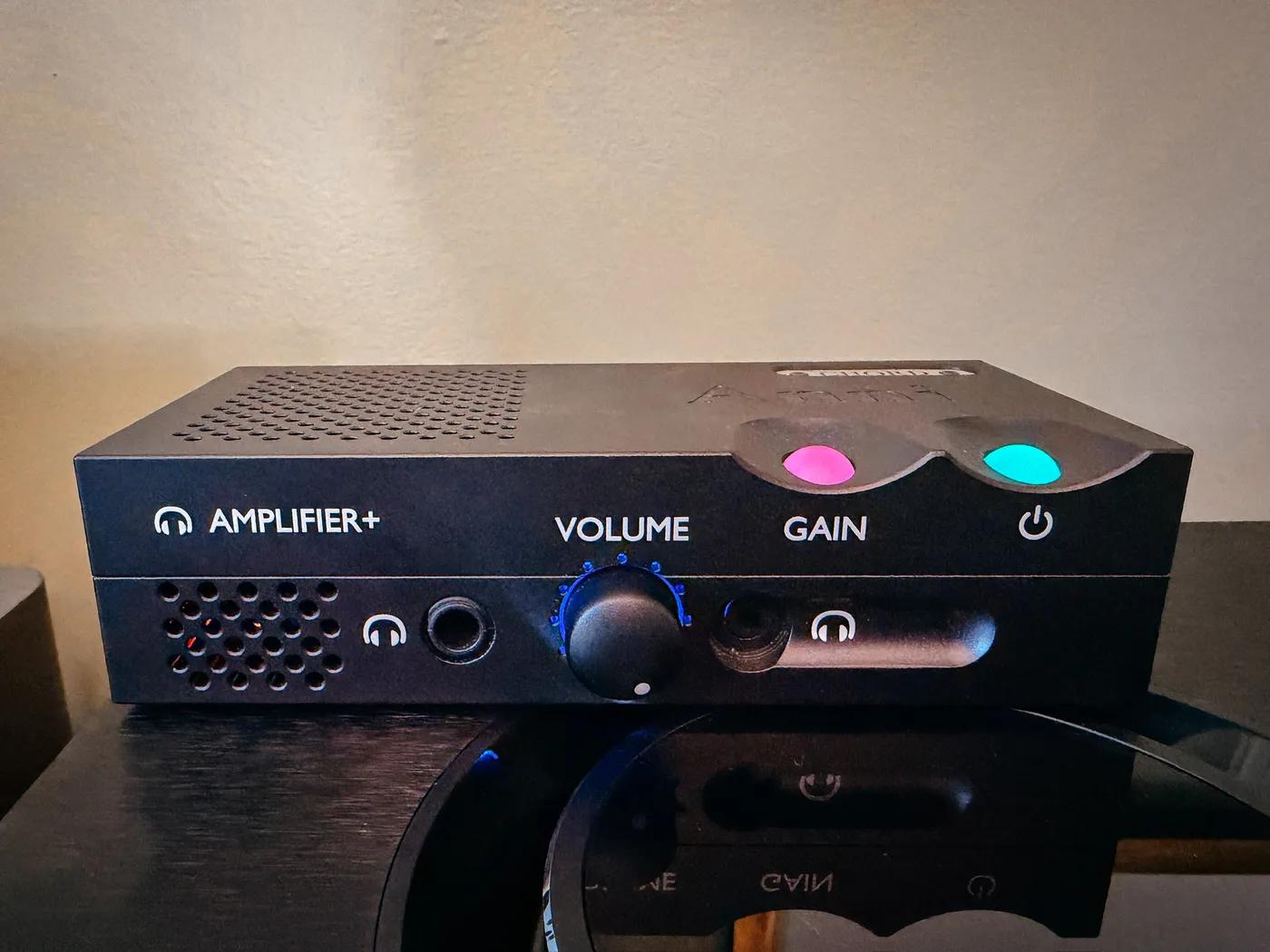
Set the Anni to high gain first. Its gain orb affects the speaker outputs only, and the two positions are roughly +5dB and a shade over +13dB. On an 85dB speaker that eight decibel difference is the whole ballgame. Mine was in high gain, red, for every minute of this test, and I want that on the record because it means what follows is a real result and not a setup mistake.
Then I ran the Anni near the top and did volume upstream. With the Qutest feeding it, I settled at about 90 percent on the Anni’s dial and did my actual volume control from the WiiM Ultra. I was not out of road, there was a little left, but I was working in the top tenth of the range rather than the middle of it. Worth knowing that the WiiM handles volume in the digital domain, with a 32-bit intermediate, so the loss is small but it is not a passive analog attenuator.
So I raised the Qutest to 3V. The Qutest has three selectable output voltages, 1V, 2V and 3V, and it is not obvious how to change them. You press the FILTER and INPUT buttons together during the first 16 seconds after power-on, and repeat to cycle through the levels (Chord’s manual). It remembers the setting, and the power orb tells you which one you are on: red is 1V, green is 2V, blue is 3V. I went from green to blue, and the step up was audible immediately, which makes sense because 2V to 3V is about 3.5dB. At 3V I had comfortable drive to work with.
Then the sub was too loud. Turning everything up to compensate threw off the balance with the KC62, so I had to pull the subwoofer level back in the WiiM’s settings. Worth flagging because it is a cascade: one level change downstream forces two more upstream, and if you skip either one you end up judging a system that is simply out of balance.
None of this is a knock on the Anni. It is a desktop amplifier being asked to run a living room, and the fix is thirty seconds of setup. But if you plug an Anni into a pair of Metas and it sounds anemic, work through this before you blame the amp.
The orb trap that will fool you
The Anni has a gain orb on its top plate, and it only affects the speaker outputs. Low gain is roughly +5dB, high gain a shade over +13dB, and blue illumination means low while red means high (Headfonics). Headphones are always forced to low gain regardless of the setting.
Here is the trap, and it is a nasty one if you are running the Chord stack I am. The two orbs invert. On the Qutest, blue is the highest output setting. On the Anni, blue is the lowest gain setting. Same brand, same glowing sphere, opposite meaning. Read the Anni’s orb the way you have trained yourself to read the Qutest’s and you will think you are maxed out while sitting eight decibels down, which is exactly the amount that would make anyone declare this pairing a failure.
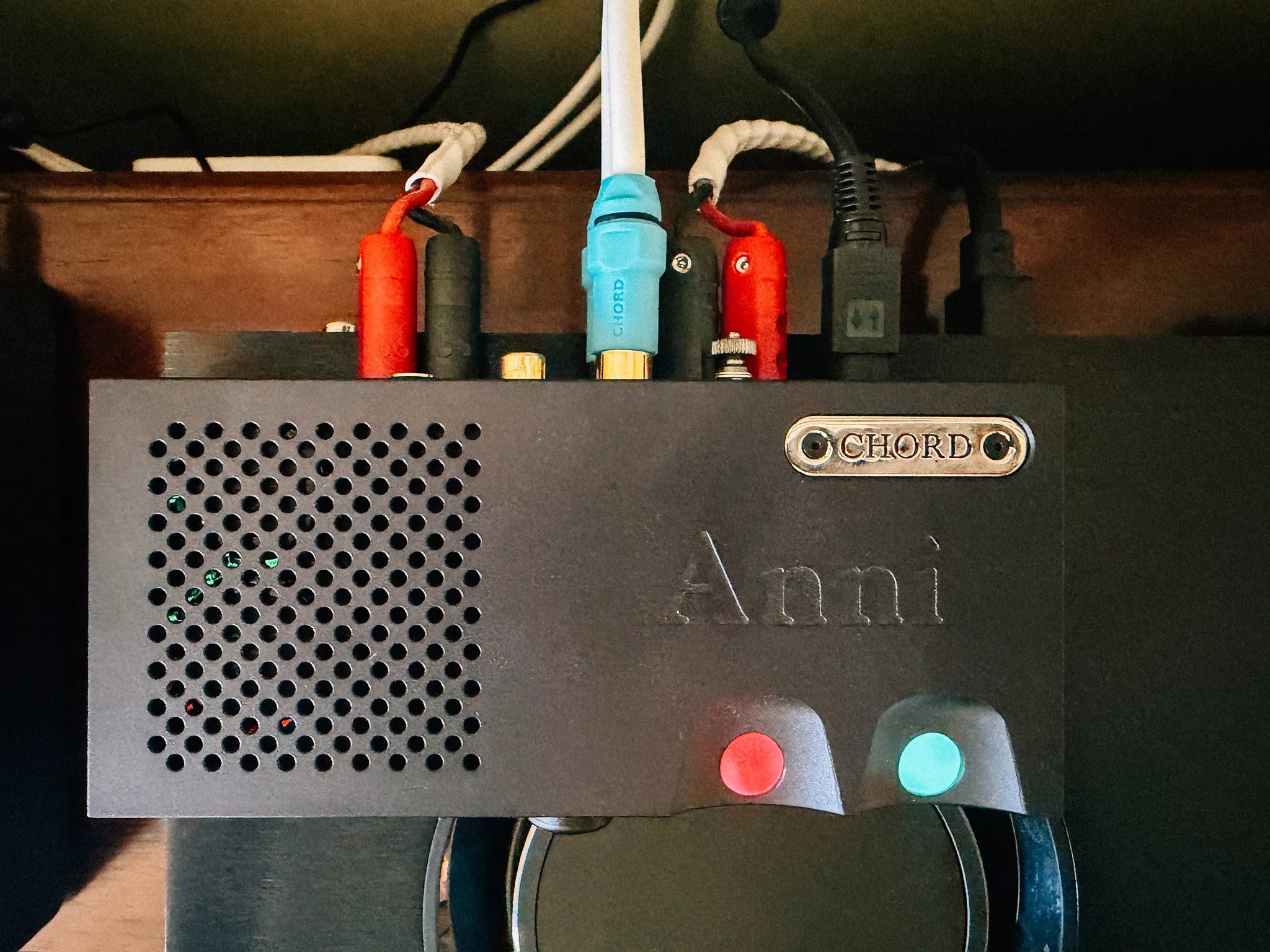
So: red on the Anni, blue on the Qutest. That is the configuration everything below was heard in, and the photo above is the proof rather than my memory of it.
Why 10 watts is not really 10 watts
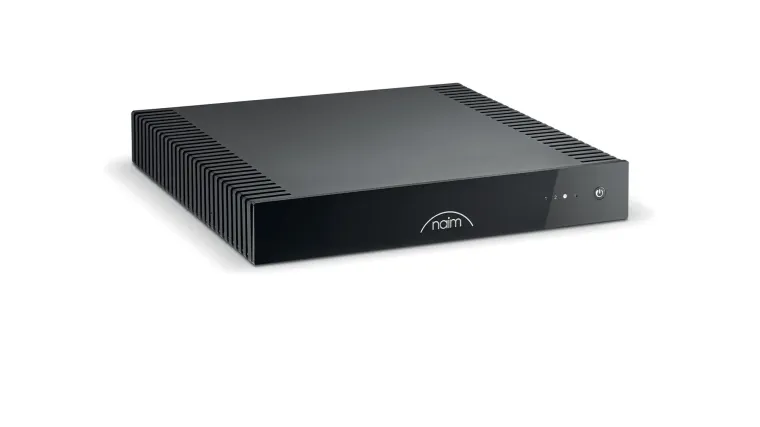
The headline spec undersells it. Chord rates the Anni at 10 watts into 8 ohms, but Hi-Fi News measured dynamic output of 13W, 20W, 35W and 60W into 8, 4, 2 and 1 ohm loads (Hi-Fi News lab report).
That doubling-into-lower-impedance behavior is what actually matters here, because the LS50 Meta’s demand is not really about watts, it is about current when the impedance drops in the bass. Into the Meta’s roughly 3.5 ohm dip, the Anni is delivering something closer to 20 watts than 10.
Set against that, the Atom’s 40 watts into 8 ohms is not the four-times advantage the numbers imply. It is closer to a doubling in the region that counts. Which is roughly what I heard: a real difference, but not a different league.
The number that explains what I heard
Rated against rated, the Atom’s 40 watts against the Anni’s 10 is exactly four times the power, which is 6dB. That is the entire story of this comparison in one figure, and it is not a subtle margin.
Here is why 6dB matters more than it sounds. At 85dB sensitivity, 10 watts produces roughly 95dB at one meter. Back at a real listening seat, with both speakers contributing and the room taking its cut, you are realistically in the high 80s. Music peaks sit 15 to 20dB above average level, so a comfortable 85dB average is quietly demanding peaks around 100 to 105dB. That is the exact point where the Anni runs out and the Atom does not.
Which is why the thing I heard was not a lack of volume. It was punch that came and went. The Anni has the energy right up until a transient asks for more than it has, and then it politely declines. Six decibels is the difference between an amplifier that has room for the peak and one that is meeting it at the ceiling.
For context on what the speaker actually wants, KEF’s own guidance lands around 40 to 100 watts and owners tend to settle on “100 watts and ideally more” before the speaker fully opens up (KEF USA amp-pairing guide). Both of these amps are below that. One is just further below it.
How it actually sounded
Here is the honest headline: still pretty fantastic. Not a compromise, not a science experiment. A system I would happily listen to all evening.
The soundstage was the surprise. At times the Anni presented music as noticeably more three-dimensional in width. Not in depth, and that distinction matters, the front-to-back layering did not grow. But the lateral spread and the sense of space between instruments had a character the Atom does not produce. It was not better exactly. It was different, and different in a way I kept noticing, which is more than most amplifier swaps manage.
You can hear the missing power. The general energy of the music felt relaxed. It kept some punch, but the punch was not consistent, and consistency turns out to be the thing. With the Atom, the drive is simply always there underneath the music. With the Anni it comes and goes depending on what the track is asking for. That is what an amplifier running out of headroom sounds like, and it is much easier to hear on an A/B than in isolation. Notably this was never a volume problem. I had all the level I wanted. It was a peaks problem.
Vocals were the tell. I did most of this listening on Tom Misch’s Full Circle, and his voice was the clearest single difference. Through the Atom it sits further forward, more present, more physically in the room. Through the Anni it steps back. Given Headfonia describes the Anni’s own voicing as full-bodied and vocal-strong, I suspect I am hearing headroom rather than tonality, the amp declining to push a dense mix as hard.
Wiring the Atom back in
The moment I put the Naim back, the extra power was obvious. Not subtle, not something I had to strain for. More grip, more presence, more of that consistent energy underneath everything.
So I stayed with the Atom, and I want to be careful about what that does and does not mean. It does not mean the Anni failed. It means that with something to compare it against, the more powerful amp won on the axis I care most about, which is presence. Run the Anni on its own for a week with nothing to A/B against and I do not think you would feel short-changed. That is genuinely how good it sounds.
What it really did was sharpen a suspicion I have been carrying for a while, and which drove my ongoing search for the right amp for these speakers. If 40 watts audibly beats 20, and the speaker is asking for 100 or more, then I have never actually heard what the LS50 Metas can do. That is the whole reason I have been looking hard at the Arcam SA45 and its measured 300-plus watts into 4 ohms. This test did not answer that question. It made it louder.
Who the Anni is actually for
Chord did not build the Anni as a living room amplifier, and my test is slightly unfair to it. Its natural habitat is a desk: nearfield listening, where you sit two feet from the speakers and the power demand collapses, and where it doubles as a genuinely excellent headphone amp. In that context, paired with a Qutest or another Chord DAC, it is a beautiful thing.
Consider it if: you want one small, gorgeous box to run both headphones and a pair of standmounts on a desk, you listen nearfield or at moderate levels, and you already own or want Chord’s house sound.
Look elsewhere if: the speakers are across the room, you listen loud, or you own something as insensitive as the LS50 Meta as your main system. It will drive them. It will not be the last amp you buy for them.
If you want this reasoning applied to your own gear rather than mine, the gear advisor will do it in about thirty seconds.
The test I want to run next
This comparison was, in fairness to the Anni, close to a worst case. The LS50 Meta is one of the least sensitive standmounts you can buy, and I asked a desktop amplifier to run it across a room.
So the next test is a fairer one. I also own a pair of KEF Q350s, and a Rega Brio to put against the Anni. That matchup is more interesting for two reasons. The Q350 is 87dB sensitive, two decibels easier to drive than the LS50 Meta, and two decibels is real money when you only have 10 watts to spend. And the Brio is rated at 50 watts into 8 ohms, which puts it in the same broad territory as the Atom rather than in a different universe.
If the Anni closes the gap on the Brio the way I suspect it might with a slightly kinder speaker, that tells you the story here was never that the Anni is underpowered. It is that the LS50 Meta is unusually hungry. That is the piece I want to write next.
The verdict
The Chord Anni is capable of powering the KEF LS50 Meta, and the answer to the question everyone should be asking is simply yes. But “capable” is doing real work in that sentence. It needs a 3V source, it needs its high gain setting, and it needs you to accept a relaxed presentation in exchange for a soundstage that genuinely does something the bigger amp does not.
Against the Atom, I chose the Atom, for presence. Against a 100 watt amplifier, I suspect both of them lose. That is the next test.
7 / 10 in this system. Higher on a desk, which is where it was always meant to live.