UMIK-1 vs UMIK-2: Do You Need the $195 Measurement Mic?
A measurement microphone is the least glamorous thing you can buy for a hi-fi system and the one most likely to change how it sounds. The question is not whether to own one. It is whether the expensive one earns its price, and the honest answer depends almost entirely on what you point it at. For the job most people are buying it for, the cheap one is not a compromise.
Matt · · 4 min read
The number that decides this
The UMIK-1 costs $79. The UMIK-2 costs $195.
The specification that actually separates them is not the price or the capsule size. It is the noise floor. The UMIK-2’s equivalent input noise sits around 20 dB SPL against roughly 30 dB for the UMIK-1. Ten decibels is a large margin in this context, and it is the whole argument for the expensive microphone.
Now the part that surprises people: the UMIK-1 handles louder sound than the UMIK-2 does. Maximum SPL is 133 dB on the cheap one and 125 dB on the expensive one. You are not buying more headroom. You are buying a quieter microphone, and giving up 8 dB at the top to get it.
That trade tells you exactly who each mic is for.
What you are actually measuring
Here is the thing that reframes this entire purchase, and it took me a while to internalize it: for room correction, you are working almost entirely below 500 Hz, and mostly below 300 Hz.
That is where rooms misbehave. Standing waves, modal peaks, the null that makes a bass line disappear in one chair and boom in the next. It is where every meaningful correction happens, whether you are running Dirac Live, REW, or the correction built into a WiiM.
In that range, at the levels you measure at, a calibrated UMIK-1 is not the weak link. Your speaker position is. Your listening position is. The fact that the sofa is against the back wall is. I have never once looked at a measurement and thought the microphone was what stood between me and a better answer.
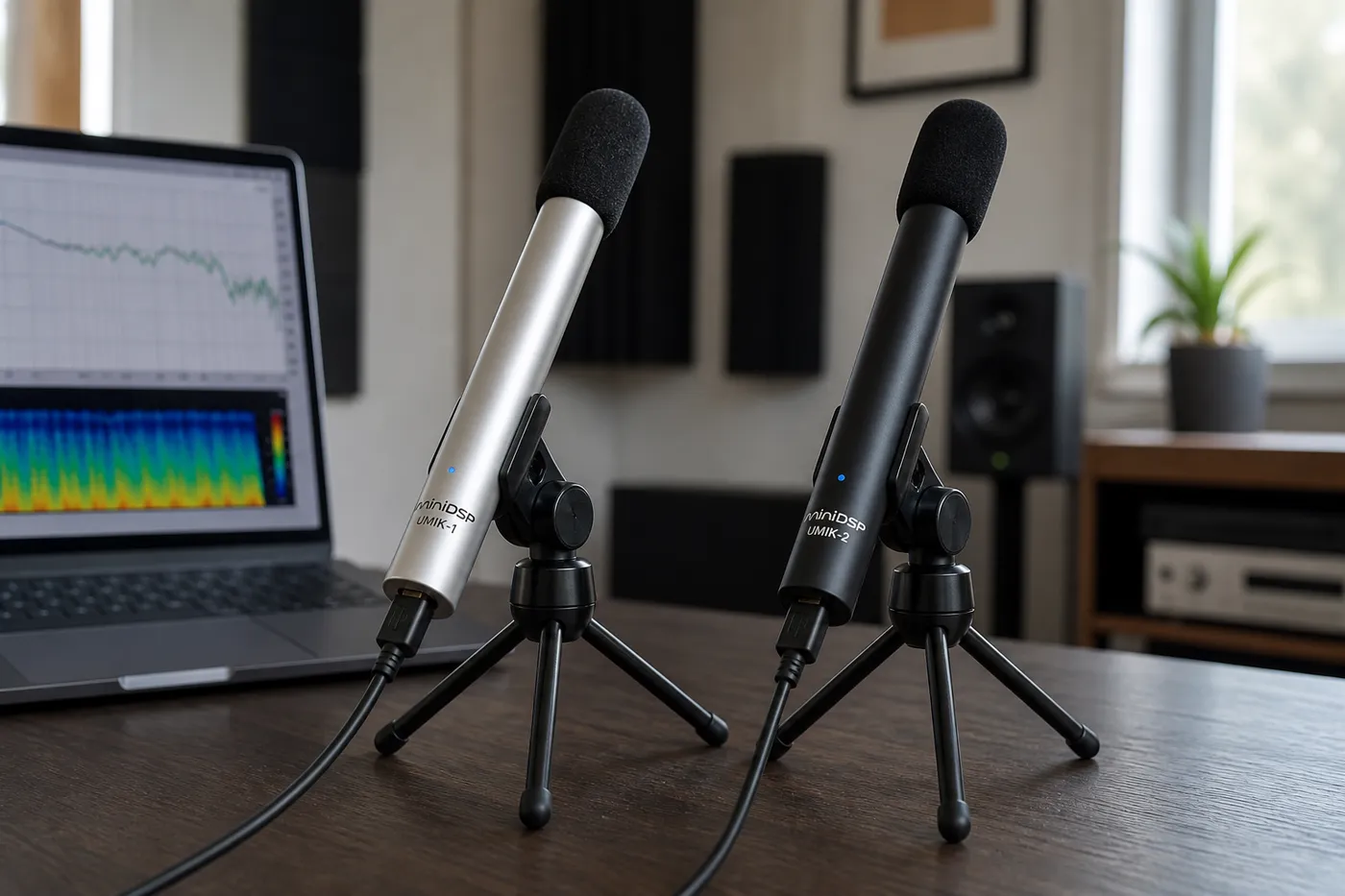
miniDSP’s own product naming is honest about the distinction: the UMIK-1 is a calibrated measurement microphone, the UMIK-2 is a reference one. Both are accurate. One is held to a tighter standard.
When the UMIK-2 earns its price
The noise floor stops being an abstraction the moment you measure something quiet.
Decay and reverb tails. A waterfall plot shows energy decaying over time, and the useful part of that decay is the quiet part. A microphone with a 30 dB noise floor stops telling you the truth about a decay before a 20 dB one does. If you are chasing room treatment rather than just EQ, this is the measurement that matters and the extra 10 dB is real.
Room noise floor itself. If you want to know how quiet your room actually is, and whether that HVAC hum is eating your low-level detail, you need a microphone quieter than the thing you are measuring.
Anything approaching a professional standard. The 32-bit recording and 192 kHz sampling on the UMIK-2 mean you can measure without setting gain carefully and without worrying about clipping. The UMIK-1 tops out at 48 kHz, which caps what you can see at 24 kHz. That is above the audible band and irrelevant for room work, but it matters if you are measuring drivers rather than rooms.
The USB-C connector is a small thing that I will still argue for. Mini-USB in 2026 means finding a cable that lives nowhere else in your house.
The mistake that ruins measurements on either mic
Both microphones ship with an individual calibration file tied to the serial number on the body. It corrects for that specific unit’s deviation from flat.
Load it. Every time, in whatever software you are using.
Measuring without the calibration file is the single most common way people end up chasing a problem that does not exist, and it is a bigger error than the entire difference between these two microphones. A UMIK-1 with its calibration file loaded is more accurate than a UMIK-2 without one. That is not a close call.
Buy a cheap mic stand too. Hand-holding a measurement microphone puts your body in the measurement.
So which one?
You want to fix your room’s bass and you have never measured before: UMIK-1. Spend the $116 you saved on a mic stand and treatment. This is most people, and it is not a compromise.
You are running room correction software and want it fed properly: UMIK-1. Every major package expects it, and its calibration file makes it accurate where it counts.
You are measuring decay, reverb, or room noise floor, or doing treatment work rather than EQ: UMIK-2. The 10 dB quieter noise floor is the reason it exists.
You measure drivers and speakers, not just rooms: UMIK-2, for the 192 kHz ceiling and the 32-bit headroom.
I measure with a UMIK-1 and I have not felt limited by it for room work. The best case for the UMIK-2 is not that it is more accurate where you are looking. It is that it stays accurate somewhere the UMIK-1 runs out, and most people never go there.
If you are not sure which camp you are in, you are in the first one. Buy the UMIK-1, learn what your room is doing, and let the measurements tell you whether you ever needed more microphone. That is a better sequence than the reverse, and it is $116 cheaper to find out.
Frequently asked questions
Is the UMIK-2 worth it over the UMIK-1?
For room correction below roughly 500 Hz, no. The UMIK-1 at $79 is accurate enough that your speaker placement and room are the limiting factors, not the microphone. The UMIK-2 earns its $195 when you measure quiet things, because its noise floor is about 10 dB lower.
What is the difference between the UMIK-1 and UMIK-2?
The UMIK-2 has a larger half-inch capsule, 32-bit recording, 192 kHz sampling, USB-C, and an equivalent input noise near 20 dB SPL. The UMIK-1 has a quarter-inch capsule, 48 kHz sampling, mini-USB, and roughly 30 dB SPL noise. The UMIK-1 handles higher peaks, at 133 dB versus 125 dB.
Can I use the UMIK-1 with REW and Dirac Live?
Yes. The UMIK-1 is the standard measurement microphone for Room EQ Wizard and works with Dirac Live, and each unit ships with an individual calibration file matched to its serial number. Load that file before you measure or every reading will be slightly wrong.