Audyssey vs Dirac Live: Is the Upgrade Worth $349?
Every comparison of these two starts from the assumption that they are rivals. They are not, quite. One is already installed in the receiver you own, and the other is a paid upgrade to the same box. That changes the question from which is better to whether the difference is worth three hundred dollars in your specific room, and the honest answer varies more than anyone selling either one would like.
Matt · · 4 min read
Start with what you already own
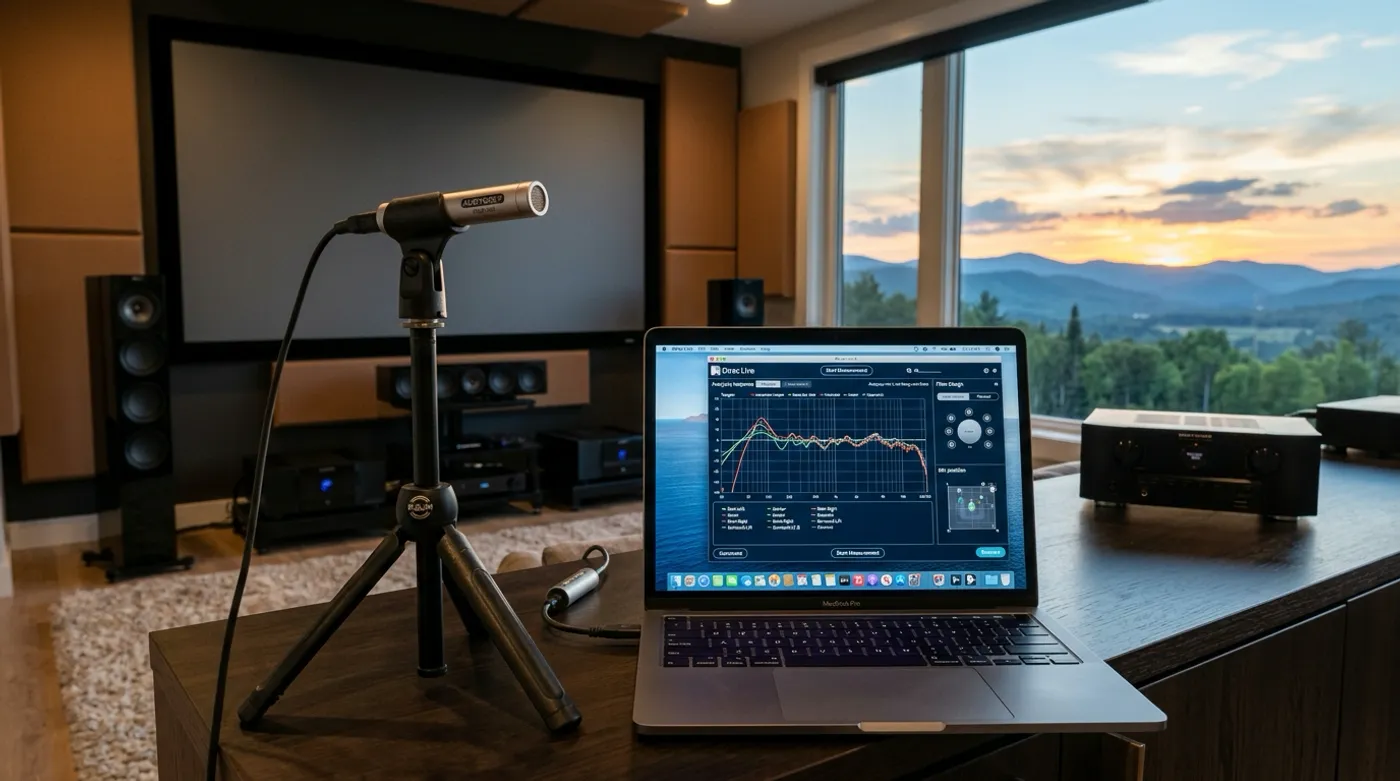
If you have a recent Denon or Marantz receiver, Audyssey is in the box and costs nothing. Dirac Live is a license you buy for that same receiver, and the pricing runs roughly $259 for the limited bandwidth version and $349 for full bandwidth. Dirac Live Active Room Treatment is a further add-on at around $299.
So this is not a purchase decision between two products. It is a question about whether to spend the price of a decent DAC upgrading correction software on hardware you have already paid for.
That framing matters, because it sets the bar. Dirac does not have to be better than Audyssey. It has to be $349 better, in your room, on your speakers.
The actual technical difference
Audyssey corrects primarily in the frequency domain. It measures the response at your listening positions and builds filters that flatten what it finds.
Dirac Live does that and also corrects in the time domain. It uses mixed-phase filters that address phase and timing relationships between frequency bands, not just their levels. In practice this means Dirac can tighten the arrival of bass, not only its quantity.
That is a genuine capability difference and it is not marketing. It is also the reason Dirac tends to pull further ahead as a room gets harder, because timing problems are what make bad rooms bad.
Where this gets less clear cut is that Audyssey XT32 is genuinely strong in the exact place most people need help. XT32 applies very high resolution filters to the subwoofer channel, on the order of 3 Hz increments, and MultEQ can handle multiple subwoofers by time-aligning and level-matching each one before equalising the combined result. That is not a token implementation. For a single-subwoofer system in a reasonably behaved room, plenty of careful listeners have compared the two and found the gap narrow enough that they kept the free one.
Both things are true. Dirac is more capable, and Audyssey XT32 is often enough. Which one describes your situation depends on your room, and you cannot know without measuring.
The $19.99 step almost everyone skips
Before spending anything on Dirac, buy the Audyssey MultEQ Editor app. It is a one-time $19.99 on iOS and Android and it addresses most of what people complain about with stock Audyssey.
It lets you see the before and after curves, edit the target curve per channel pair, adjust the high frequency rolloff, and set a limit on how high in frequency the correction operates. That last one is the big one. A great deal of Audyssey dissatisfaction comes from letting it correct across the full range, where room correction has no business operating and where it can make a system sound flat and lifeless. Restricting correction to the modal region below a few hundred Hz is often the entire fix.
If you have not tried Audyssey with the Editor app and a sensible frequency limit, you have not actually heard what Audyssey can do, and you are not in a position to judge whether Dirac is worth $349. That is the most useful thing in this article.
Where Dirac clearly earns it
Difficult rooms. Open plan spaces, rooms with hard asymmetry, seating against a back wall. Timing correction matters most where reflections and modes are worst.
Multiple subwoofers with Bass Control. Dirac’s subwoofer handling with the Bass Control add-on is genuinely a step beyond, and if you run three or four subs this is where the money goes.
You want ART.Active Room Treatment has no Audyssey equivalent at all. It uses your existing speakers to counteract room resonances, and whatever you make of the naming, there is nothing comparable on the free side.
You have already optimised everything else. Speaker placement, seating position, and treatment all beat correction software. If those are genuinely done, Dirac is the next real step.
A note on where this sits
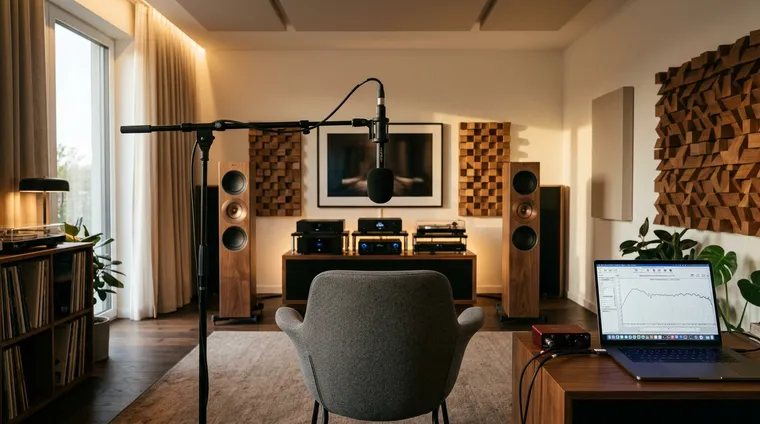
This is receiver territory, which is a step away from the two-channel systems I usually write about. If you are running a stereo setup rather than a surround system, the comparison you actually want is REW against Dirac Live, or the alternatives to Dirac that work outside the AVR world entirely. REW is free, cross-platform, and will teach you more about your room than any automatic system, at the cost of doing the work yourself.
So which one?
You own a Denon or Marantz and have not tried the Editor app: spend $19.99, limit correction to the modal range, and listen for a month before spending more.
Simple rectangular room, one subwoofer, and Audyssey XT32 already sounds good: keep the money. The upgrade is real but small here.
Awkward room, multiple subwoofers, or bass that never quite locks in: Dirac Live full bandwidth. This is what the phase correction is for.
You are running two-channel without a receiver: neither. Start with REW and a UMIK-1.
Audyssey is not the budget option that you outgrow. It is a capable system that most people run badly, at full bandwidth, without ever opening the editor. Fix that first. If you do the free work properly and your room still fights you, that is the moment Dirac Live is worth $349, and you will know it because you will have the measurements that prove it.
Frequently asked questions
Is Dirac Live better than Audyssey?
Dirac Live corrects phase and timing across frequency bands as well as frequency response, while Audyssey corrects primarily in the frequency domain. That makes Dirac more capable in difficult rooms. In a simple room with one subwoofer, many listeners report the two landing close enough that the upgrade is hard to justify.
How much does Dirac Live cost on a Denon or Marantz receiver?
Licenses are sold per unit, with a limited bandwidth version around $259 and full bandwidth around $349. Dirac Live Active Room Treatment is a separate add-on at roughly $299. Audyssey is included with the receiver, and the MultEQ Editor app is a one-time $19.99.
Should I buy the Audyssey MultEQ Editor app first?
Yes. At $19.99 it lets you set the correction frequency limit, adjust target curves per channel pair, and see before and after results. It solves the most common Audyssey complaints for a fraction of a Dirac license, so try it before spending ten times more.