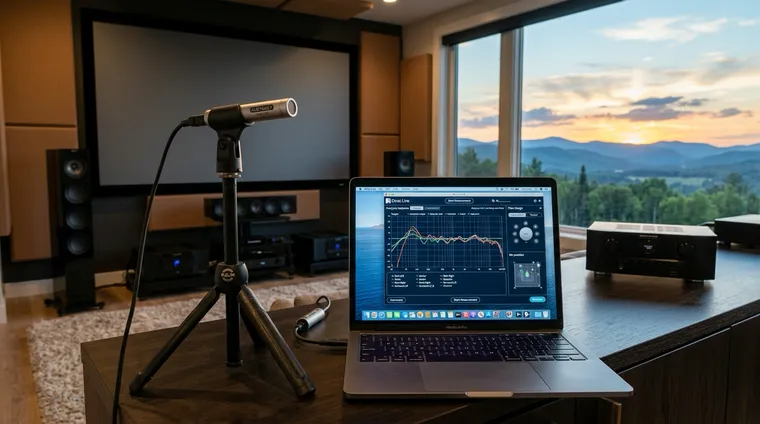
Audyssey vs Dirac Live: Is the Upgrade Worth $349?
Audyssey came free with your receiver. Dirac Live costs $259 to $349 on top. Here is what the money actually buys, which rooms need it, and when Audyssey XT32 is already enough.
In the only controlled blind test of room correction products ever published, one product was rated no better than doing nothing, and another was rated much worse. That result should change how you shop for this. Here is the honest map of the alternatives, what each one costs all-in, and which ones your system can actually run.
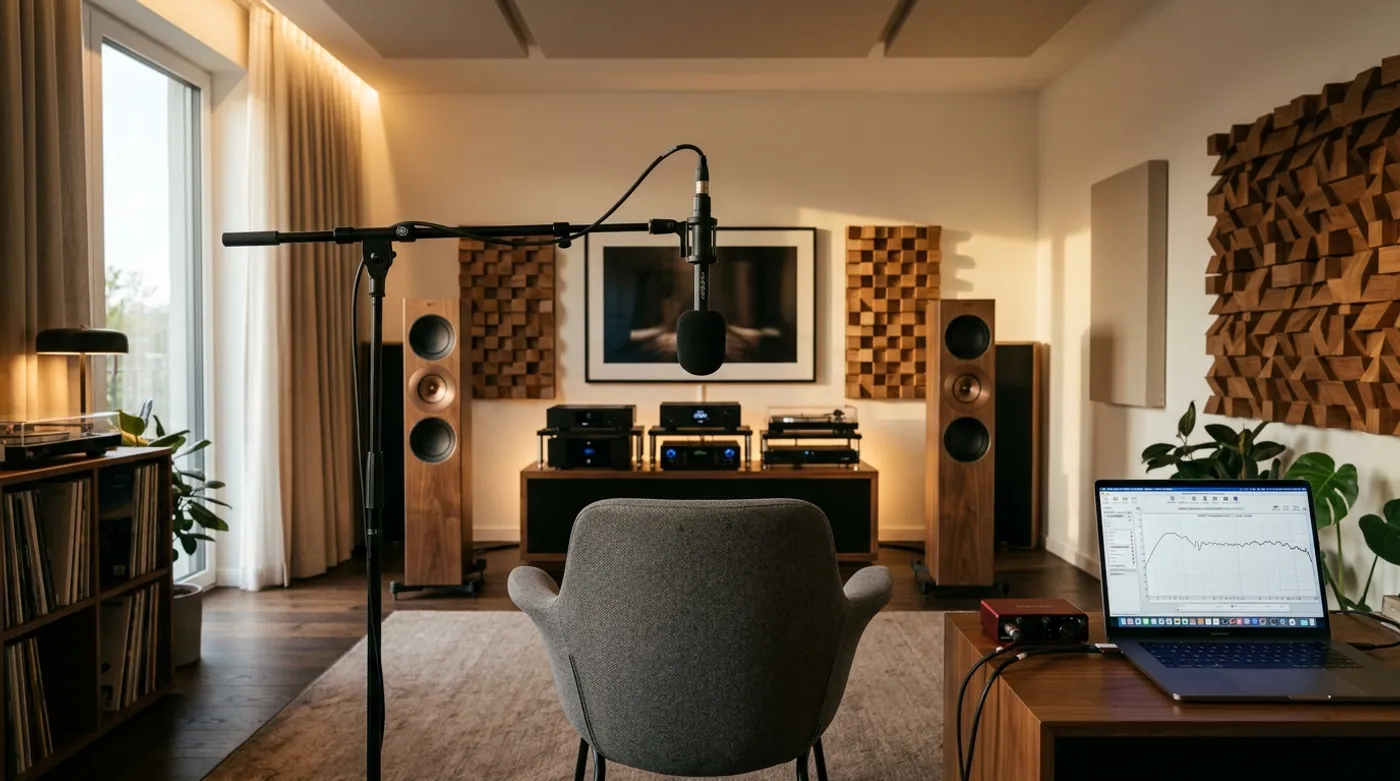
Room correction is sold as an algorithm argument. Dirac against Audyssey, ARC against RoomPerfect, mixed-phase against minimum-phase. Spend an evening on any forum and you will find confident people telling you the engine is what matters.
The evidence says otherwise, and the number that reframed this whole topic for me comes from the only properly controlled test of these products anyone has published. Sean Olive and a team at Harman ran a double-blind, level-matched, randomized comparison of five commercial room correction products against a hidden “no correction” anchor, with eight trained listeners (AES 127th Convention, preprint 7960). Three of the five were strongly preferred over doing nothing. One was rated equal to no correction. One was rated much worse.
The products that lost were described as thin and bright. They had stripped the bass out. And the thing that predicted listener preference was not time-domain behavior or filter sophistication. It was spectral balance, the overall tonal shape the correction landed on.
That study is from 2009 and nothing published since has superseded it. There is still no blind test of the current generation, which means every “Dirac beats Audyssey” thread you have read is sighted, uncontrolled, and written by someone who spent money on one of them.
Once you know preference tracks spectral balance, a lot of the forum noise resolves.
The practical version: when you hold the target curve and the volume constant, listeners largely cannot tell these engines apart in the frequency domain. One experienced user compared Acourate and Audiolense at a matched target and could not distinguish the filters under focused listening (What’s Best Forum). Different math, same curve, same sound.
There are two real exceptions, and they are worth knowing because they are where your money actually goes. The first is phase and timing, which is why WiiM’s built-in correction gets described as imaging diffusely next to Dirac; RoomFit corrects frequency response and does not touch phase or impulse response (WiiM forum). The second is multiple subwoofers, where joint optimization is genuinely hard and free tools handle it badly.
Everywhere else, you are mostly arguing about a curve you could have chosen yourself.
Two more things follow from the Olive study that contradict what people assume. A flat in-room response is not the optimum; the preferred results sloped gently downward with frequency. And the reason so many people report that correction “killed my bass” is that flat bass sounds like missing bass. That is an expectation gap, not a malfunction.
This is the part I did not expect to find, and it holds across three different companies.
When Audyssey’s app shows you a before-and-after curve on a Denon or Marantz, those curves are simulations rather than measurements. Amir at Audio Science Review called them “simulated lies” after his own REW measurements failed to match the app’s prediction (ASR). Anthem’s ARC Genesis does something similar: it displays a calculated post-correction curve, and one user measured roughly 1 dB of variation on ARC’s own chart against about 7 dB in REW at the same position, including a 6 dB dip between 50 and 130 Hz (ASR). Whether that is a bug or an artifact of spatial averaging is still unresolved. Even Dirac’s founding technical paper presents performance figures that are labeled simulated, with no listening test attached (Brännmark and Sternad, ISEAT 2015).
The pretty graph you get afterward is usually a picture of what the software intended to do, not a measurement of what happened in your room. The only way to know is to measure it yourself with a microphone and REW. If you take one practical thing from this article, take that.
All-in, as of July 2026. The trap in every “REW is free” recommendation is that REW measures and designs filters but cannot play audio, so the real cost is whatever hosts the convolution.
| Path | Cost | The catch |
|---|---|---|
| REW + Equalizer APO or CamillaDSP | Free + mic | Equalizer APO is bypassed entirely by ASIO and WASAPI exclusive mode |
| HouseCurve (iOS) | $20/yr or $60 lifetime | Measures with your iPhone; still needs a host for the filters |
| WiiM Ultra | $329 | Correction included, no license, no mic to buy |
| Roon | $12.49/mo or $829.99 lifetime | Convolution included; needs a Core running somewhere |
| miniDSP Flex | ~$570 + $199 Dirac upgrade | Inserts between source and amp, keeps your existing gear |
| Dirac Live Processor (PC/Mac) | $349 stereo, $499 multichannel | The computer must be your playback source |
| Dirac Bass Control | $299 add-on | Requires full-bandwidth Room Correction first |
| Dirac ART | $299 add-on | Only on certified hardware, or the PC/Mac Processor |
| Audyssey MultEQ-X | $199.99 | Denon and Marantz only, tied to one serial number |
| Sonarworks SoundID Reference | $249, or $299 with mic | Mac and Windows only, frequently discounted |
| Acourate / Audiolense | €416 / €410 | Steep learning curve, filters follow you anywhere |
| Anthem ARC Genesis | Free software | Anthem, Paradigm, or MartinLogan hardware only |
| Lyngdorf RoomPerfect | Bundled, ~$2,200 and up | TDAI-1120 is the cheapest way in |
| Trinnov | ~$11,000 and up | The ST2 Hi-Fi is discontinued |
The cheapest credible path is about $60 to $130, using HouseCurve or free REW with free convolution, with a measurement microphone as the real constraint. The cheapest turnkey path is $329, a WiiM Ultra, where correction is built in and nothing is licensed to anything.
And Dirac’s actual floor is lower than people assume: $349 plus a microphone on a computer you already own, not the $570-plus hardware route most guides point you toward.
Here is the detail that changes the value calculation, straight from Dirac’s own support documentation: a Dirac Live license transfers only when you sell the hardware to a new owner, or when you get a same-model warranty replacement. Out of warranty with no replacement, Dirac will not reissue it onto new hardware, and using one license across multiple devices is explicitly unsupported (Dirac helpdesk).
So your $349 to $799 is not an asset you own. It is a capability rented against one box, depreciating on that box’s schedule.
To be fair, this is a category norm rather than a Dirac-specific sin. Audyssey’s MultEQ-X is $199.99 and equally welded to a single AVR serial number (Sound & Vision). The honest framing is that paid correction stays with the hardware, and free tools follow you. REW, HouseCurve, Acourate, and Audiolense will still be working for you across every amplifier and streamer you buy for the rest of your life.
Most guides organize this by vendor. That is useless, because your hardware has already made most of the decision for you. The hardest and most common case is a streamer, an integrated amp, and passive speakers, with no AV receiver and no computer in the chain. Four options, in ascending order of disruption:
Insert a DSP box. A miniDSP Flex sits between your streamer and your amplifier, takes digital or analog in, and feeds a line input. Stereo full-range Dirac is a $199 licence on top of the hardware, plus a UMIK microphone. This is the only path that keeps both your existing streamer and your existing amp.
Replace the streamer. A WiiM Ultra at $329, an Eversolo DMP-A6, or a Bluesound NODE. WiiM and Eversolo are cheapest by a wide margin because the correction is included rather than licensed, though both are bass-focused and neither corrects phase.
Replace the amp. A NAD C 399 or a Lyngdorf TDAI-1120. One box, correction native. Note the trap here: the NAD C 3050, C 379, C 389 and C 399 need the MDC2 BluOS-D card installed before Dirac works at all (NAD). People buy a “Dirac product” and discover it cannot run Dirac until they buy the module.
Add Roon. Convolution is included in the subscription, but the Core has to run somewhere, so this reintroduces a computer even if it lives in a closet.
Worth knowing before you spend an evening researching something you cannot use.
Linux users are shut out of every commercial option. Dirac’s Processor is Windows and macOS only, and so is Sonarworks. CamillaDSP on a Raspberry Pi is the answer, and it is genuinely good, but it is the only answer.
Windows users running ASIO or WASAPI exclusive mode silently bypass Equalizer APO. That is precisely the playback configuration most audiophiles use, which makes “just use Equalizer APO, it’s free” bad advice for the people most likely to receive it.
Anyone with an analog-only chain, a turntable into an integrated amp with no digital insert point, needs to add an ADC before any of this applies.
Dirac Live Processor cannot correct a turntable, a CD transport, or a phone streaming to another device, because the correction is a virtual audio device on the computer. The computer has to be the source.
And nothing corrects at the phone. If you stream from a phone, your correction has to happen downstream in a WiiM, a Bluesound, an Eversolo, or a miniDSP.
Below roughly 200 to 300 Hz, correction is close to mandatory. That is where the room dominates, where a single mode can put a 10 dB peak in your bass, and where the improvement is obvious.
Above that, it gets contested. Floyd Toole’s position is that the peaks and dips you see above the transition frequency are acoustic interference between direct and reflected sound, a non-minimum-phase phenomenon that minimum-phase EQ structurally cannot fix, and that correcting them “can add new spectral variations” with real risk of degrading a good loudspeaker (JAES 63, 2015). The counter-argument is that in-room response genuinely varies by more than 18 dB below 300 to 500 Hz and that measured reality should win over theory.
The most honest data point I found is behavioral rather than theoretical. Amir at ASR argues that full-range correction has a legitimate basis, and then runs Dirac in the bass region only in his own system (ASR). The gap between what people defend in principle and what they actually run is the most useful thing in the entire debate.
One hard limit that no product escapes: you cannot EQ away a null. REW’s own documentation demonstrates it with a worked example, where a dip that appears to be 6 dB at 100 Hz turns out to be a 17 dB dip at 98 Hz at proper resolution, and 24 dB of boost produced massive distortion, clipping, and a worse result just outside the sweet spot (REW). A cancellation affects direct and reflected sound equally, so boosting raises both and they keep cancelling. In modeled real rooms, nulls typically run around 25 dB deep (Welti and Devantier, JAES 54, 2006), which would need roughly 316 times the power to fill.
Nulls are fixable, just not by EQ. Move the speaker, move the seat, or add subwoofers. That is the actual sequence, and EQ comes last.
If you have one subwoofer and a stereo system: start free. REW plus a convolution host, or HouseCurve if you would rather use your phone. Buy a UMIK microphone. Spend the money you saved on getting the speakers and the seat in better positions, which outperforms every product on this page.
If you run multiple subwoofers: this is where Dirac earns it. Bass Control jointly optimizes crossovers, phase and arrival time across subs and mains, and no free tool does that well. It is the strongest case for paying.
If the license is already in your box, use it. Onkyo’s multichannel Dirac receivers include full-bandwidth correction at no extra charge, not the limited 500 Hz tier most buyers assume (Onkyo). If you own one, Dirac is the rational default because the marginal cost is zero.
If you want to spend nothing and think about it least: a WiiM Ultra at $329. Correction included, phone-based measurement, nothing bound to anything. Worth knowing before you buy: the cheaper WiiM Pro Plus does not include room correction at all, and the Bluesound Node at more than twice the price does not either. It will not match Dirac on imaging because it does not correct phase, and for a lot of rooms that will not be the limiting factor anyway.
I have deliberately not told you which engine sounds best, because the evidence does not support anyone who does. What the evidence supports is that the curve matters more than the code, that the graph you are shown is probably a prediction, and that the cheapest option in this article fixes most of what is actually wrong with your room.
Two honest ones. First, the anchor study is from 2009. Every product in it has been superseded, and nobody has run a controlled blind comparison since, so the strongest claim in this piece rests on a test of a previous generation. That gap is the single biggest problem in this entire category, and it is not mine to fix alone.
Second, I have not personally measured every option here. My own room runs REW, and the comparative claims come from published measurements and manufacturer documentation rather than a bench I control. Where sources disagreed, and they disagreed constantly, I have kept both sides rather than picking the tidier answer.
If you have run a level-matched comparison between two of these engines at a matched target curve, I would genuinely like to see it. That is the experiment the whole category is missing.
Audyssey came free with your receiver. Dirac Live costs $259 to $349 on top. Here is what the money actually buys, which rooms need it, and when Audyssey XT32 is already enough.
Spotify, Apple Music, Amazon, and YouTube Music all raised US prices in 2026, and Tidal is next. Here is what each service costs now, what you get for the money, and who the hikes make the worst buy.

Dirac ART uses your speakers and subs to shorten bass decay at your mic positions. Here is what Active Room Treatment actually does, which receivers support it, what the $299 add-on costs, and what has been tested.