Klipsch spent nearly seventy years putting Heritage badges on floorstanders, then showed up at High End Vienna in June with a bookshelf. The Rebellion is the first compact standmount in that line, hand-built in Hope, Arkansas, priced at $2,599 a pair in the US.
I own a pair of KEF LS50 Metas. I do not own Rebellions. Nobody should read what follows as a verdict on how the Klipsch sounds, because I have not heard it. What I can do is read the spec sheet against the speaker I actually live with, and be honest about which parts of that comparison are real.
The real part is the amplifier. The Meta is 85 dB sensitive and dips toward 3.5 ohms in the bass, which is why finding an amp for them has been an ongoing hunt rather than a purchase. Klipsch rates the Rebellion at 95 dB. That is the number that made me look twice. A Heritage speaker that would sit on a stand in a normal living room, and might not need the current the Metas keep asking for, is a genuine fork in the road. Whether I would take it is a listening question, and I have not done the listening.
What it actually is
Not a Cornwall. Not a Heresy. Not a shrunken Klipschorn.
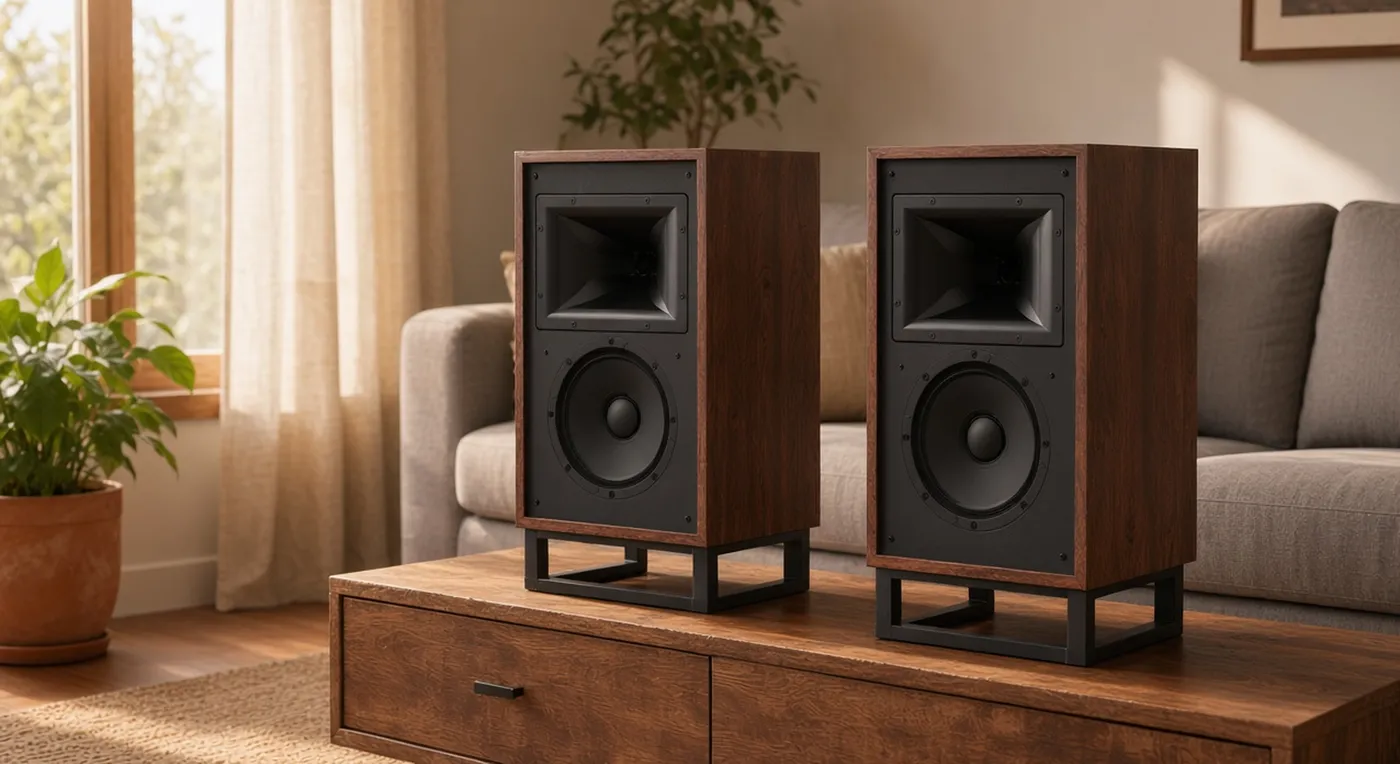
The Rebellion is a two-way, rear-ported bookshelf descended from Paul W. Klipsch’s 1958 H8, a rare compact design of which Klipsch says only 16 were made. The original was imagined as a center speaker between a pair of Klipschorns. The 2026 version is being sold as a stereo pair, and as a way to put Heritage into a room that will not accept a three-way floorstander.
The recipe, from Klipsch’s own spec sheet:
- K-702 compression driver on a K-703 Tractrix horn with Mumps geometry at the mouth
- New K-81-EP 8 inch woofer
- Rear Tractrix-flare port, which Klipsch says is new for Heritage
- 18 mm MDF cabinet with book-matched real wood veneer
- Cloth grille, 5-way binding posts, 10-year warranty
Finishes are Black Ash, Walnut, and an 80th-anniversary Tigerwood. Matching KS-24 stands are a separate purchase.
It is assembled in Hope, like the rest of Heritage. That is not marketing fluff in the way a “designed in” line often is. The cabinet is furniture, and it looks like it.
The specifications
| Klipsch Rebellion | KEF LS50 Meta |
|---|
| US pair price | $2,599 | $1,599.99 |
| Format | Passive two-way, rear port | Passive two-way, rear port |
| HF | K-702 on K-703 Tractrix horn | 25 mm aluminium dome in Uni-Q, MAT |
| LF | K-81-EP 8 inch woofer | 130 mm (5.25 inch) Uni-Q cone |
| Crossover | 715 Hz | 2.1 kHz |
| Sensitivity | 95 dB @ 2.83V, half-space | 85 dB (2.83V/1m) |
| Impedance | 8 ohm nominal, 3.3 ohm min at 170 Hz | 8 ohm nominal, ~3.5 ohm min |
| Frequency response (±3 dB) | 60 Hz to 20 kHz | 79 Hz to 28 kHz |
| Frequency extremes | 45 Hz to 21 kHz (-10 dB) | 47 Hz to 45 kHz (-6 dB) |
| Max output (claimed) | 115 dB, calculated | 106 dB |
| Power handling / amp guidance | 200 W (AES) | 40 to 100 W recommended |
| Cabinet (H x W x D) | 19.1 x 12 x 9.6 in. | 11.9 x 7.9 x 11.0 in. |
| Weight each | 14.51 kg (32 lb) | 7.8 kg (17.2 lb) |
| Coverage | 90° H / 60° V (stated windows) | Uni-Q wide, even dispersion |
| Built | Hope, Arkansas | China |
| Warranty | 10 years | 5 years |
Rebellion figures from the Klipsch spec sheet, v06. LS50 Meta figures from KEF’s published spec and the long-term review I already wrote. LS50 street price is the current US pair figure from KEF’s US shop.
Two rows in that table do most of the work, and they are easy to misread.
Sensitivity is not a clean 10 dB win. Klipsch measures the Rebellion half-space, 1 metre, 2.83 V. KEF’s 85 dB is the usual 2.83 V/1 m rating, not the same boundary condition. Half-space numbers run hot compared with a free-field curve. Treat “ten times the acoustic power” as marketing maths until someone measures both the same way. What you can still say, without faking a listen: Heritage is built to be efficient, the Meta is not, and my Naim Uniti Atom at 40 watts is living proof of that gap on the KEF side.
The impedance still dips. 3.3 ohms at 170 Hz is not an easy 8 ohm load. High sensitivity and a nasty minimum can coexist. A low-powered SET that looks perfect on the 95 dB headline can still run out of current in the bass. I would want to see a full impedance curve, or at least hear a pair on something other than a 200 watt demonstration amp, before I called them tube-friendly.
The crossover is the other number I would not bury. 715 Hz means the horn is doing the midrange. The Uni-Q in the Meta hands over at 2.1 kHz, so most of a vocal lives in one cone with a tweeter in its acoustic centre. The Rebellion splits that vocal across a compression driver and an 8 inch woofer. That is not a defect. It is a different loudspeaker. Anyone telling you these will image the same way from a spec sheet is guessing, and that includes me.
The comparison that is actually honest
I can tell you what the Metas do in my room. I cannot tell you what the Rebellions do in anybody’s.
The Metas disappear. That is still the thing I would buy them for. Close your eyes and the boxes stop being the source. They resolve more than their size and price suggest, they do not wear me out over a long session, and they are ruthlessly honest about the amplifier in front of them. Underpower them and they sound polite and closed-in. Feed them and they open. I have now heard that from both directions: the Atom at 40 watts, which is below what they want, and a 10 watt Chord Anni dropped into the same rack, which was more listenable than the paper said and still lost presence first.
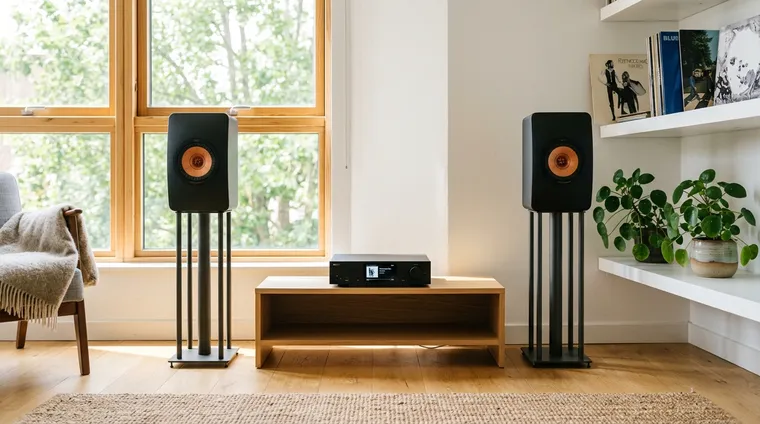
I run a KEF KC62 underneath them. Physics did not get repealed by Uni-Q. A 5.25 inch standmount becomes a full-range system in a small footprint once the sub is in, and a little room correction makes the hand-off stop announcing itself.
That is the speaker I would be comparing a Rebellion against. Not a review-week LS50. Not a KEF brochure. A pair on a sideboard, closer together than they should be, sharing a surface with a turntable, because that is the room I actually have.
Against that, here is what the Rebellion is asking me to believe.
It wants less amplifier. Even with the half-space caveat, a 95 dB two-way with an 8 inch woofer is a different job for the Atom than 85 dB and a 5.25 inch Uni-Q. The entire reason I keep shopping for amps is the Meta. If the Klipsch really does wake up on 40 watts, that search gets smaller. I would still want current for the 3.3 ohm dip. I would not be hunting 200 watt Class G as a precondition for the speaker making sense.
It wants more cabinet. 19.1 inches tall, 32 pounds, 8 inch woofer. The Meta is a compact cube you can lose on a sideboard. The Rebellion is a small piece of furniture. Klipsch’s own photography puts them on stands or a long console, and the KS-24 exists because 19 inches on a low table aims the horn at your chest. In my room that is not a small change. It is the difference between “the person I live with will tolerate this” and “we are putting stands in the living room.” I already lost that argument with the Metas. A taller, heavier Heritage box does not win it back.
It claims more bass on paper, and still might want a sub. 60 Hz ±3 dB against 79 Hz is a real difference in the published curves. Klipsch also publishes 45 Hz at -10 dB, and an 8 inch cone in a ported box should move more air than a 5.25 inch Uni-Q. I would still budget for a sub if the goal is the same full-range system the KC62 gives me. A standmount that “doesn’t need a sub” is usually a standmount measured in a kind room at a kind level.
It will not disappear the way a Uni-Q does, or it might, and I will not pretend to know. Horns have a presence. That can be the point. It can also be the thing you hear during a quiet vocal and cannot unhear. The 90° by 60° coverage windows on the spec sheet are narrower than what Uni-Q is for. Off-axis is how I live with a messy placement. A speaker that wants you on-axis is a speaker that wants stands, distance, and a chair that does not move. That is a lifestyle cost, not a graph.
What the people who have written about it actually said
There is no full review I would trust yet. What exists is launch coverage.
What Hi-Fi folded the Rebellion into the 80th-anniversary Klipschorn story: horn-loaded tweeter, 8 inch woofer, Tractrix port, $2,599, July 2026 in North America. No stars. No listening notes. That is a show roundup doing its job.
Darko wrote the launch note in June and flagged the thing that mattered: the first press release did not quote sensitivity or impedance. Those numbers arrived later, on the spec sheet above. If you read an early piece that says Klipsch withheld the efficiency figure, that was true in June and is not true now.
I have not found a Stereophile review, and I have not found an Audio Science Review measurement. Until those exist, anyone quoting “smooth, even, low distortion” is quoting Klipsch. The compact two-way horn is an integration problem. Get the crossover and the off-axis right and it sings. Get it wrong and you get a forward midrange and a presence-region glare that a short show demo will not reveal. That is the Klipsch pattern, not a review of this pair.
Klipsch said North American availability would start in July 2026, with EMEA in the autumn at a US-equivalent $2,999. As of mid-September 2026, at least one US dealer was still listing September 2026 shipping and KS-24 stands later in the fall. Check current stock before you treat July as history.
If a pair landed next to my LS50s, with the same WiiM Ultra, the same Qutest, and the Atom first so the amp question is isolated, this is the list.
Voices at the 715 Hz split. A spoken-word track, then a single vocal with almost no production. I want to know whether the horn and the woofer agree about where a person is standing. The Meta’s party trick is that they do, because there is only one place the sound is coming from.
Whether they disappear. If I can still point at the cabinets with my eyes closed, that is information. It might still be a speaker I like. It would not be a speaker that replaces what I bought the Metas for.
Level without hardness. The Atom has headroom to spare on a 95 dB box, in theory. I would turn it up past the point where the Metas start to sound like they need more amp, and listen for the glare people report on small Klipsch two-ways. A show demo at high volume in a treated room is the wrong test. An hour in a live room is the right one.
Bass with the KC62 off, then on. I want the Rebellion’s own 60 Hz claim in my room, then I want to know whether a sub still helps or whether the 8 inch and the port already get in the way of a clean hand-off.
The sideboard test. Same terrible placement the Metas live with. If they only work on KS-24s, two metres out, aimed at one chair, they are a different product than a compact coaxial that still images from a piece of furniture. I would rather know that than pretend I have a dedicated room.
None of that is a review. It is the demo I would run before I spent $1,000 more than the Metas cost, and before I told anyone the amp search was over.
Who this is for, on paper
Someone who wants Heritage character in a room that will not take a Heresy IV, let alone a Cornwall. The Heresy is a compact floorstander at roughly $3,200 a pair. The Rebellion undercuts that and asks for a stand instead of floor space. If the horn voicing is the reason you like Klipsch, this is the first time that company has sold you that idea in a genuine bookshelf.
Someone who is tired of feeding LS50 Metas. That person is me, some days. The honest version of that fatigue is “I need more current,” not “I need a different brand.” A more efficient speaker is one answer. A better amplifier is the other, and I have been circling the Arcam SA45 and NAD M10 V3 for exactly that reason. I would not rip out a pair of Metas I still like on the promise that 95 dB will fix a 40 watt ceiling.
Someone who buys on measurements should wait. There is a spec sheet. There is not a third-party measurement set. That is a fine reason to keep your wallet closed.
Skip it if you already have LS50 Metas, a sub, and an amp that actually drives them. You would be paying more for a larger box and a different set of compromises, and you would be doing it without a listen. Skip it if you thought this was a Cornwall. It is not. Skip it if a forward horn midrange has ever worn you out. That tendency is the thing I would test first, and I have not tested it.
What I actually think this is
The news is not that Klipsch made another horn speaker. The news is that Heritage finally has a standmount, and it is priced and sized for the same kind of room the LS50 Meta was designed to live in.
That is as far as a spec sheet can take a comparison. The Meta’s job, in my system, is coherence: one point in space, then a sub for the notes the cabinet cannot make, then an amplifier search I have not finished. The Rebellion’s job, on paper, is dynamics on less power, from a bigger cone and a horn that owns the midrange. Those are not the same job. I will not pick a winner between a speaker I have lived with and a speaker I have only read about.
If I get a pair in the room, I will update this. Until then, the Metas stay where they are.