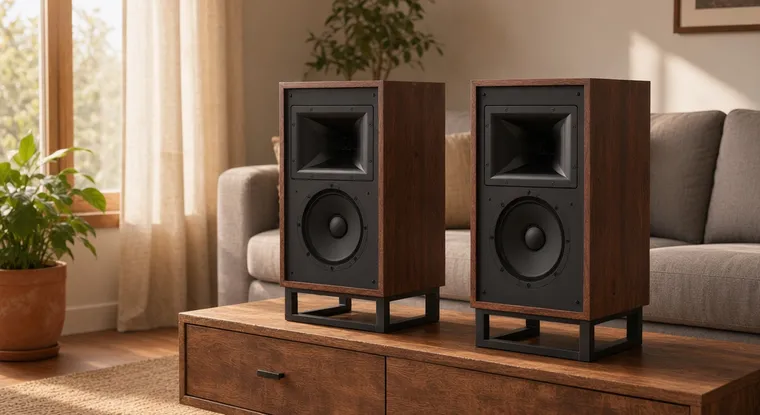
Klipsch Rebellion vs KEF LS50 Meta: What I'd Want to Hear
Klipsch's new Heritage bookshelf is 95 dB sensitive and $2,599 a pair. I own LS50 Metas, not Rebellions. Here are the specs, the amp question, and what I would actually listen for.
Cambridge Audio has built an all-in-one that undercuts the KEF LS50 Wireless II by $400 and out-powers it by 20 watts a side. I have not heard it. But the spec sheet and the early listening notes tell a fairly clear story about who it is for.
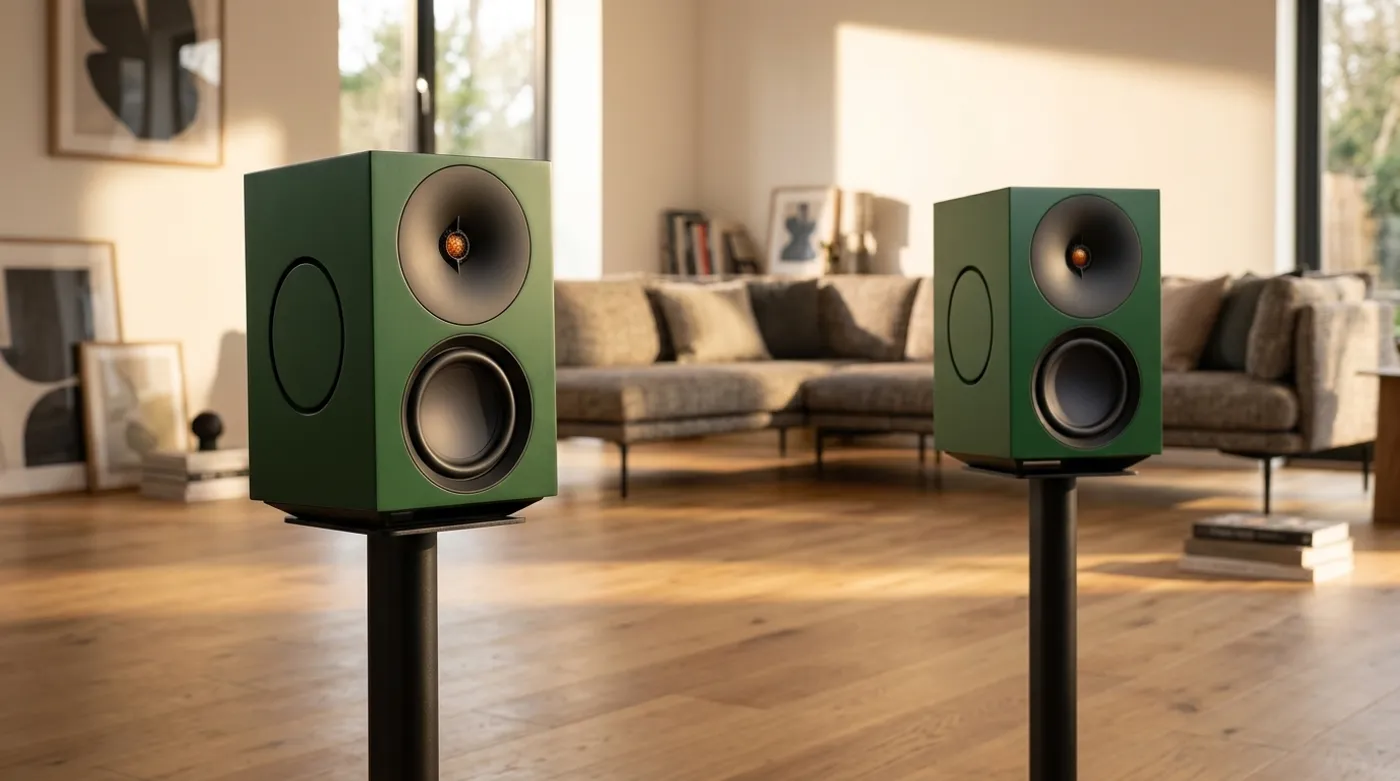
Cambridge Audio has spent years making the boxes that go between other people’s speakers. The L/R series is the first time they have made the speakers too, and the flagship L/R X is aimed at exactly one competitor.
I have not heard them. Nobody outside a handful of reviewers has, and the ones who have were working from short demos rather than living with a pair. So this is a look at what Cambridge has actually built, what it costs, and what the early listening notes agree on, not a verdict on how it sounds.
I am interested for a specific reason. I wrote about the KEF LS LUXE last week and argued that the interesting thing about it was not the technology but the room it was designed for: the one with other jobs to do, where a rack of separates is never going to be allowed. That argument had a hole in it. At $4,000, the LS LUXE answers that question for people with $4,000. The L/R X answers it for a lot more people.
An active, wireless, two-box stereo system. Each speaker has its own amplification, its own DAC, and its own streaming platform. There is no separate amp, no separate streamer, no box of components.
The driver arrangement is unusual and worth understanding, because it is where Cambridge diverged from KEF rather than copying them. It is a 2.5-way design: a 28 mm tweeter in a torus-shaped chamber, a front-facing 5 inch woofer, a second 5 inch woofer built into the base of the cabinet firing downward, and a pair of 6 inch passive radiators mounted on the sides in opposition so their forces cancel.
That last detail is the clever part. Side-firing passive radiators in a facing pair push against each other, so the cabinet does not shake itself. It is a way of getting bass out of a small box without the enclosure adding its own noise to the music.
KEF’s answer to the same problem is completely different. The Uni-Q puts the tweeter in the acoustic centre of the mid-bass driver so the sound arrives as one piece from one point in space. Both approaches work. They do not sound the same, and anyone telling you which is better from a spec sheet is guessing.
| Price | $2,399 per pair |
| Range | L/R S $549, L/R M $1,599, L/R X $2,399 |
| Amplification | 2 x 400 W Class D per speaker, 800 W total |
| Drivers | 28 mm torus-chambered tweeter, 2 x 5 inch woofers, 2 x 6 inch force-cancelling passive radiators |
| Configuration | Active, 2.5-way |
| Max resolution | 24-bit/96 kHz |
| Streaming | StreamMagic Gen4 |
| Inputs | HDMI eARC, RCA stereo analogue, moving magnet phono, Wi-Fi, Ethernet, Bluetooth |
| Interspeaker link | Wireless, or wired over USB-C |
| Dimensions | 200 x 333 x 260 mm per speaker |
| Finishes | White, Black, Blue, Walnut, Orange, Green |
Two things are missing from that table because Cambridge does not publish them: sensitivity and impedance. On an active speaker those matter far less than they would on a passive one, since the amplifier and the driver were designed for each other and you are not being asked to match anything. It is still a conspicuous omission on a product page that lists six paint colours.
Six finishes is not a throwaway detail either, and I will come back to it.
A built-in moving magnet phono stage is the quietly excellent detail here. It means a turntable, a pair of speakers, and nothing else is a complete system. Very few competitors at this price include one.
This is the comparison Cambridge designed the product to invite, so here it is.
| Cambridge L/R X | KEF LS50 Wireless II | KEF LS LUXE | |
|---|---|---|---|
| US price | $2,399 | $2,799 | $3,999 |
| Power per speaker | 400 W | 380 W | 380 W |
| Max resolution | 24-bit/96 kHz | 24-bit/192 kHz | 24-bit/384 kHz |
| HDMI eARC | Yes | Yes | Yes |
| Phono stage | Yes, MM | No | No |
Cambridge undercuts the LS50 Wireless II by $400, adds 20 watts a side and a phono stage, and gives up resolution to do it.
I would not weight that resolution gap heavily, and I say that as someone who just spent an article arguing about exactly this number. 24-bit/96 kHz is already beyond what anyone has reliably demonstrated hearing. The KEF’s 24-bit/192 kHz is a bigger number describing the same inaudible territory. If you are choosing between these on resolution you are choosing on the wrong thing.
One note on the price, because it has moved. The L/R X was announced at $2,299 and Cambridge’s own US store now lists it at $2,399. Check the current figure before you budget.
Every published impression so far is a short demo or a hands-on, not a review from living with a pair. With that caveat, the notes converge more than I expected.
It goes loud, and it stays composed doing it. This is the most consistent observation across every early listen. 800 watts in a cabinet this size is not a marketing number; reviewers repeatedly noted the speakers going far louder than their footprint suggests without falling apart.
The midrange is the standout. More than one listener singled out midrange clarity specifically, describing the presentation as confident and texturally detailed.
And it leans bright. This is the caveat that keeps appearing, and it is the one I would want to test. Early listeners described a slightly sharp or hard-edged quality at volume, and at least one noted it could become tiring over a long session. In a short demo at high volume that could be the room, the material, or a speaker that simply has not been run in. It could also be the voicing.
No one has committed to a verdict. The consistent line across reviews is that the signs are encouraging and more time is needed before anyone says whether it beats the KEF. That is the honest state of it, and I am not going to pretend otherwise.
A first-generation speaker from a company that has never made one. Cambridge Audio has decades of amplifier and streamer credibility and none of it transfers automatically to cabinet design and driver integration. The L/R series is their first attempt. That is not a reason to avoid it, but it is a reason to listen before buying.
Brightness is the hardest thing to live with. Every other complaint on a spec sheet can be worked around. A speaker that fatigues you is one you stop using. If the early notes are describing voicing rather than demo conditions, that is the single most important thing to find out for yourself.
The LS50 Wireless II is five years old and still the benchmark. That cuts both ways. It means KEF has had five years of firmware and a mature platform, and it means the thing Cambridge had to beat was set in 2020. A refresh from KEF changes this comparison overnight.
Active systems age on software timelines. Same argument I made about the LS LUXE and it applies here. A passive speaker is an heirloom. An all-in-one is a computer with drivers attached, and StreamMagic has to keep being supported for this to stay a good buy in 2032.
The LS LUXE piece argued that KEF built an all-in-one for the room people actually live in rather than the dedicated listening room. I still think that is right. The problem is that $4,000 is not a “most people” price, and neither, really, is $2,799.
At $2,399 with a phono stage built in, the L/R X is the first speaker of this type I would describe as broadly affordable. That is the story here, more than any comparison of watts. A turntable and a pair of these is a complete, genuinely good system in two boxes, in a room where a rack was never going to be permitted, for a number a lot of people can reach.
The 2.5-way design with force-cancelling radiators also suggests Cambridge was solving for real domestic placement rather than chasing a measurement. A cabinet that does not vibrate is a cabinet you can put on a sideboard.
And they look genuinely good, which I do not think is a soft point. I made this argument about the LS LUXE and it applies harder here: a speaker that reads as an object rather than as audio equipment gets to stay in the room, because the person you live with stops seeing it as clutter. The L/R X is distinctive enough to be noticed without being strange, and Cambridge offers it in white, black, blue, walnut, orange and green. Most hi-fi is available in black or a slightly different black.
Those colours are doing real work. A pair of these in green or orange is the thing a guest asks about on the way past, which is not how anyone has ever described a black box on a rack. If part of what you want from a system is that other people notice it and ask, that is a legitimate thing to buy for, and very few speakers at any price let you.
Whether it is better than the KEF is a question I cannot answer and neither can anyone else yet.
Someone who wants one purchase to be the whole system, has a turntable, and does not have a room they are allowed to fill with equipment. The phono stage matters more here than the watts do.
Someone who already owns good separates and likes them should skip it, as with any all-in-one. And anyone sensitive to a forward treble should treat the brightness reports as a reason to hear it before buying rather than a detail to discount.
I will update this if I get the chance to hear a pair.
Klipsch's new Heritage bookshelf is 95 dB sensitive and $2,599 a pair. I own LS50 Metas, not Rebellions. Here are the specs, the amp question, and what I would actually listen for.
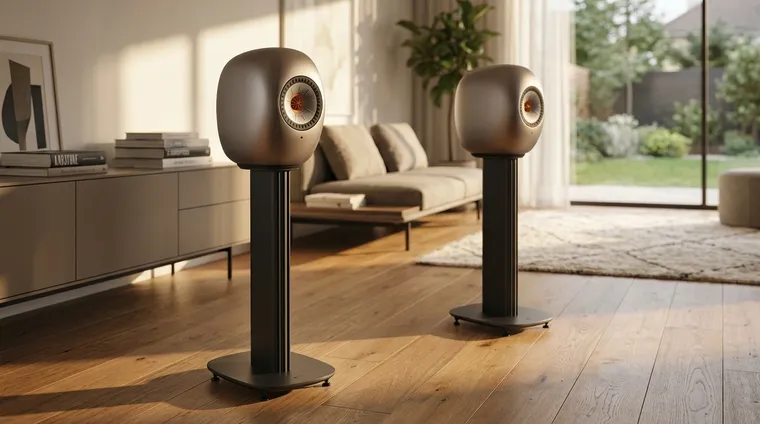
KEF's new LS LUXE is a $4,000 wireless standmount with a 12th-generation Uni-Q, 380 watts a side, and a Ross Lovegrove cabinet. Here are the specs, the price, and why I think it is aimed at the room you actually live in.
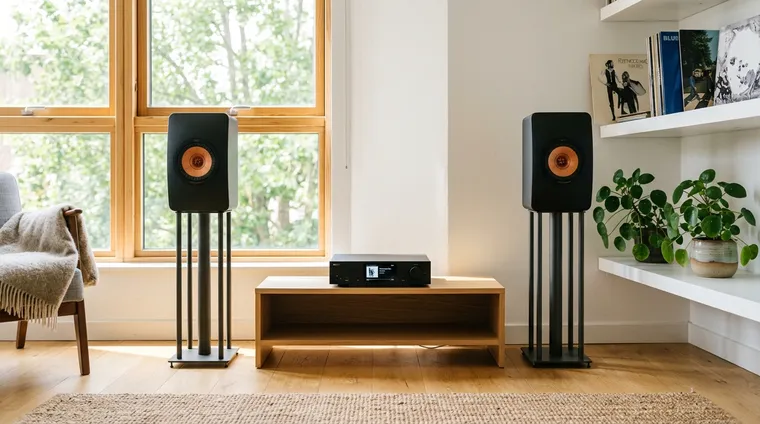
The KEF LS50 Meta is a brilliant standmount that quietly demands a serious amplifier. I own a pair, and here is my honest, still-unfinished search for the right one.