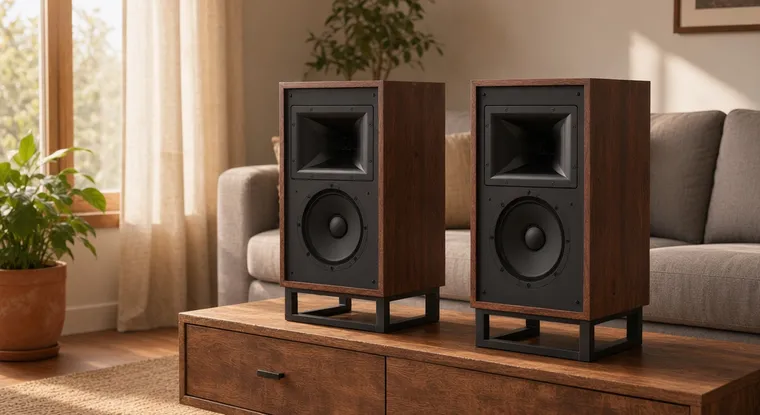
Klipsch Rebellion vs KEF LS50 Meta: What I'd Want to Hear
Klipsch's new Heritage bookshelf is 95 dB sensitive and $2,599 a pair. I own LS50 Metas, not Rebellions. Here are the specs, the amp question, and what I would actually listen for.
KEF announced the LS LUXE on July 30th: a $4,000 all-in-one standmount with a brand new Uni-Q, 380 watts per speaker, and a Ross Lovegrove cabinet. I have not heard them. But I think I understand what they are for, and it is not the dedicated listening room.
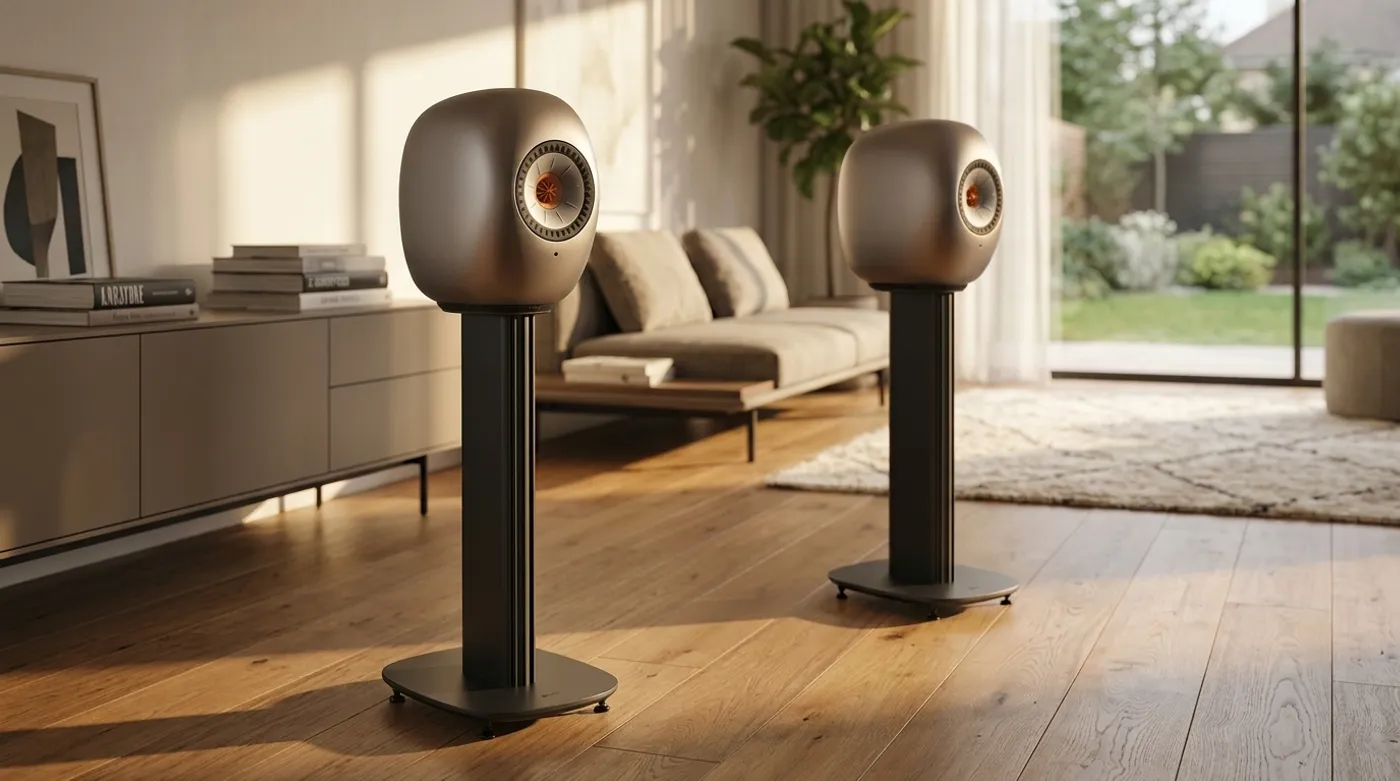
KEF announced the LS LUXE on July 30th, and it is the most interesting thing the company has launched in a while. Not because it is new technology in the abstract, but because of where it sits: a $4,000 pair of powered standmounts that slot between the LS50 Wireless II and the floorstanding LS60, wrapped in a Ross Lovegrove cabinet that looks like nothing else on a stand.
I have not heard them. Nobody outside a handful of reviewers has. So this is a look at what KEF has actually built and what it costs, not a verdict on how it sounds.
But I want to be upfront about why this one caught my attention. I own a pair of KEF LS50 Metas, and the single hardest part of owning them has been finding an amplifier that actually drives them. That search is still unfinished. So I read a spec sheet that says “no amplifier required” with more interest than most people would.
An active, wireless, two-box stereo system. Each speaker has its own amplification. There is no separate amp, no separate streamer, no box of components. You put two speakers on stands, connect them, and you have a hi-fi.
The core of it is a new 12th-generation Uni-Q driver array: a 25 mm vented aluminium dome tweeter sitting in the acoustic centre of a 165 mm (6.5 inch) aluminium mid-bass cone. That coaxial arrangement is the reason the LS50 Meta images the way it does, and this is the newest version of it.
Alongside it, two acronyms worth decoding:
The cabinet is a rounded, low-diffraction form moulded from bulk moulding compound, designed by Ross Lovegrove. It is available in Eclipse Black, Dusk Titanium and Mineral White.
| Price | $3,999.99 per pair, £3,500, €4,000 |
| Availability | myKEF early access now, wider release August 13 |
| Drivers | 12th-gen Uni-Q, 165 mm aluminium LF/MF, 25 mm vented aluminium dome HF |
| Amplification | 280 W Class D on LF/MF, 100 W Class AB on HF, so 380 W per speaker, 760 W total |
| Frequency response | 42 Hz to 28 kHz (±3 dB), 35 Hz to 47 kHz (-6 dB), EQ dependent |
| Max SPL | 110 dB |
| Dimensions | 298 x 223 x 336 mm (11.7 x 8.8 x 13.2 in.), height x width x depth |
| Weight | 20 kg (44.1 lb) per pair |
| Network audio | Up to 24-bit/384 kHz over the network input |
| Input resolutions | HDMI eARC and coax up to 24-bit/192 kHz, optical up to 24-bit/96 kHz |
| Interspeaker link | Wireless resamples all sources to 24-bit/96 kHz; wired over Ethernet resamples to 24-bit/192 kHz |
| Streaming | AirPlay 2, Google Cast, Spotify Connect, Tidal Connect, Qobuz Connect, Amazon Music, Deezer, QPlay, UPnP/DLNA, internet radio, Bluetooth 5.3 |
| Roon | Ready certification via free software update, expected 2027 |
| Inputs | HDMI eARC, optical, digital coax, 3.5 mm aux, Ethernet |
| Outputs | Dedicated subwoofer output on each speaker |
| Finishes | Eclipse Black, Dusk Titanium, Mineral White |
One number in that table deserves a second look, because a lot of the launch coverage collapsed it into a headline. The 24-bit/384 kHz figure applies to the network input, not to what reaches the second speaker. Run the pair wirelessly, which is how nearly everyone will run them, and every source gets resampled to 24-bit/96 kHz on the link between the two cabinets. If you want the speakers talking to each other at full rate, KEF gives you an Ethernet port on each one to wire them together.
That is not a scandal. 24-bit/96 kHz is beyond what anyone has reliably demonstrated hearing, and the wireless link is doing something genuinely hard. But “lossless up to 384 kHz” is a spec about the front door, and it is worth knowing which part of the chain it describes.
This is the part that reframes the price.
| Model | Price (US) | Format |
|---|---|---|
| LS50 Wireless II | $2,799 | Powered standmount |
| LS LUXE | ~$4,000 | Powered standmount |
| LS60 Wireless | $6,999 | Powered floorstander |
So the LS LUXE is a $1,200 step above the LS50 Wireless II, and it buys you a newer Uni-Q, VECO, considerably more power, HDMI eARC, and a cabinet that is the actual headline. Early reviews describe it as meaningfully ahead of the LS50 Wireless II for scale, bass authority and textural detail, which is what you would hope for at forty percent more money.
A few things worth holding onto before anyone gets carried away:
It is a $4,000 6.5 inch standmount. The 42 Hz figure is respectable for the size, and VECO is presumably doing real work to get there, but physics has not been repealed. KEF put subwoofer outputs on both speakers for a reason. My own LS50 Metas only became a full-range system when I added a KC62, and I would budget for the same here.
The design is genuinely polarising. Lovegrove’s cabinets are sculptural in a way that people either love or find fussy. Reviewers have been clear that this is not a neutral-looking speaker you slide into any room.
Bluetooth is the fallback, not the point. Reviewers noted an audible drop-off switching from the network streaming to Bluetooth. If your listening is mostly Bluetooth from a phone, you are paying for a platform you are not using.
Placement is not optional. The early consensus is that these are wasted on a desk or a sideboard. That is a real cost: proper stands and room to breathe, on top of $4,000.
Active systems age differently than passive ones. A passive speaker is an heirloom. An all-in-one is a computer with drivers attached, and the streaming platform ages on software timelines. That is not an argument against buying one, but it is a different ownership proposition than a pair of LS50 Metas you can re-amp forever. The Roon certification landing in 2027 rather than at launch is a small illustration of exactly that.
Read that list of caveats again and you can talk yourself out of the LS LUXE pretty easily. I do not think that is the right way to judge it, because I do not think KEF built it for the room where those caveats matter most.
Here is my read. If these can deliver a genuinely great experience in rooms that are not set up for hi-fi, then it is a win, and that is the whole bet. Every one of the compromises above is a compromise against a dedicated listening room. Nobody who has a dedicated listening room is the target.
I know that room, because I do not have one. I have a house with a wife who does not care about any of this and kids who care even less. The speakers live where the family lives. Every upgrade path I have ever plotted for my LS50 Metas has run into the same wall, which is not budget, it is that a rack of separates and a pair of speakers pulled three feet off the wall is a thing I am asking the rest of the household to live with. The LS LUXE is two objects. That is it. No rack, no cables snaking to an amp, nothing that looks like equipment.
And the design being polarising is exactly the point, not a risk. A Lovegrove cabinet is the difference between “what is that in the corner” and “why is there stereo gear in the living room.” A speaker that reads as an object rather than as audio equipment gets to stay in the room. That is a real feature, and I think reviewers scoring the looks on taste alone are missing what the looks are doing.
So no, this is not endgame. It cannot be. An active all-in-one ages on software timelines, you cannot re-amp it in ten years, and a 6.5 inch cone is still a 6.5 inch cone. If you are chasing the last ten percent, buy passive speakers and spend the rest of your life feeding them, which is roughly what I have been doing.
But endgame is not what most people need, and I think KEF knows it. This is a play to put real hi-fi into normal houses and sell it to a much wider audience who will genuinely benefit from good sound and were never going to build a system to get it. I think it is a great idea. For a multi-person living space it is a win-win, and I would rather more people hear something excellent in a compromised room than have a few of us hear perfection in a room nobody else is allowed to enjoy.
Someone who wants genuine hi-fi performance in a room that has other jobs to do. Someone who will never get the speakers off the wall, never get a rack past the household, and would rather have eighty-five percent of the sound with none of the argument. That buyer is far more common than the one this hobby writes for, and KEF has spent a decade learning how to serve them.
Someone who already has a dedicated room, good passive speakers and an amp they like does not need this, and would probably be annoyed by it.
The bigger mismatch is anyone who wants a system rather than a product. If half the fun is swapping an amp, auditioning a DAC, or moving the speakers into a new room and starting over, there is nothing here to swap. It is two sealed objects and a subwoofer output, and that is the entire upgrade path. I gave that up for reasons that had nothing to do with sound, and I am fine with it, but it is a real thing to give up. If your room is large, or you want bass you feel through the floor, the LS60 at $6,999 is the more honest answer. And if the price is what stops you rather than the concept, Cambridge Audio’s L/R X makes the same argument for $1,600 less, with a phono stage built in.
I will update this if I get the chance to hear a pair.
Klipsch's new Heritage bookshelf is 95 dB sensitive and $2,599 a pair. I own LS50 Metas, not Rebellions. Here are the specs, the amp question, and what I would actually listen for.
Cambridge Audio's L/R X is a $2,399 active speaker with 800 watts, HDMI eARC and a phono stage, aimed squarely at KEF. Here are the specs, what early listeners heard, and where it actually sits.
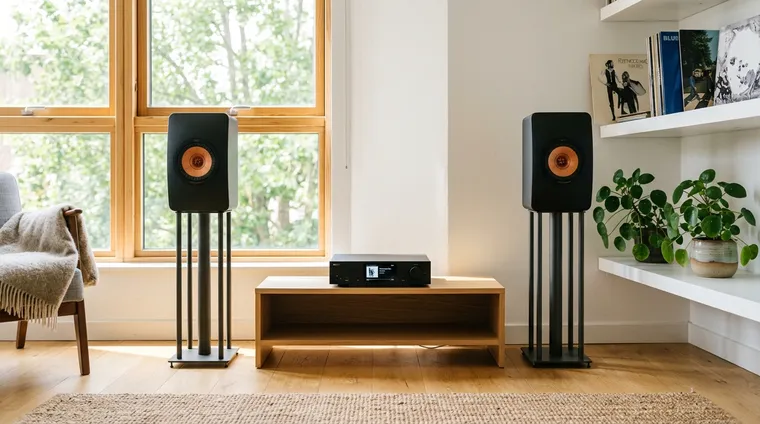
The KEF LS50 Meta is a brilliant standmount that quietly demands a serious amplifier. I own a pair, and here is my honest, still-unfinished search for the right one.