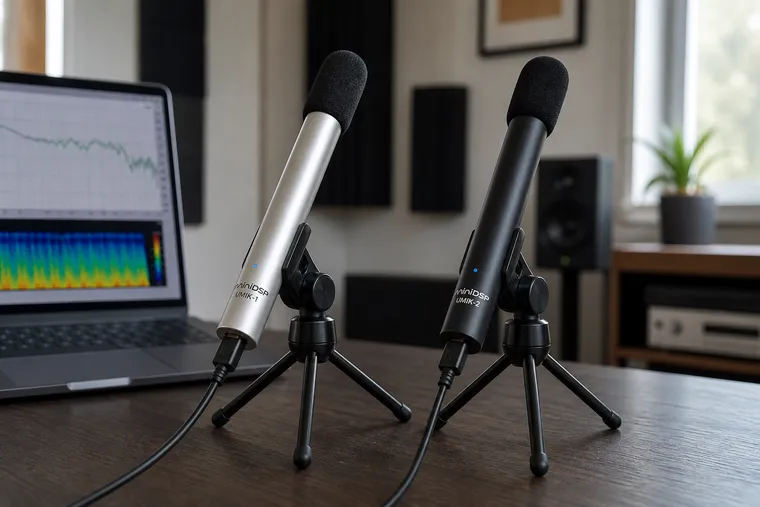
UMIK-1 vs UMIK-2: Do You Need the $195 Measurement Mic?
The UMIK-2 costs 2.5 times more than the UMIK-1 and handles 8 dB less SPL. I measure with a UMIK-1. Here is what the extra $116 actually buys, and when it is genuinely worth it.
My own DAC journey started with a Schiit box, so their new gear always gets my attention. This year it is two small, cheap accessories rather than a new DAC: a tube buffer and a USB reclocker. Here is what they claim, the honest skepticism around both categories, and where I land.

My own DAC journey started with a Schiit box, a Modi Multibit, years before I landed on the Chord Qutest I use now. So whenever Schiit launches something new, I pay attention, even when it is not a DAC. This year the news out of Schiit is two small, cheap accessories rather than a flagship converter: the Buf, a $99 tube buffer, and the Eitr 2, a $99 to $149 USB reclocker. I do not own either yet, but both are interesting enough, and cheap enough, that I think they are worth a closer look before you decide whether to add one to your own system.
A buffer is not an amplifier and not a preamp. It sits in the signal path, typically between a preamp and a power amp, and passes the audio through an active stage rather than a passive wire. The Buf does that with a tube.
Specifically, the Buf runs Schiit’s “Coherence” topology, a hybrid design pairing a 6N1P tube gain stage with a solid-state transistor, running in Class A. It ships with that NOS 6N1P tube installed, but the socket also accepts the 6922, ECC88, and 6DJ8 tube families, so tube rollers can swap it for a different flavor. Gain is switchable between 0dB and 12dB from the front panel, which is more flexible than most buffers at this price. It is assembled in Corpus Christi, Texas, and carries a 3-year warranty, 90 days on the tube itself (Darko.Audio, ecoustics).
What it is actually for: adding a touch of tube character, and potentially better drive over long cable runs, to a system that is otherwise solid-state. It is not correcting a problem so much as offering a flavor option.
Strip the marketing off and it is a box that takes a digital source and cleans it up before it reaches the DAC. In audio terms, that is a DDC, a digital-to-digital converter.
The Eitr 2 takes USB in from your computer or streamer and outputs AES/EBU, coax, or Toslink, at up to 24-bit/192kHz. The pitch is in how it does that conversion: instead of a generic USB receiver chip, Schiit built a proprietary receiver stage they call Unison, purpose-designed for audio rather than adapted from general computing hardware, aimed at more stable timing and less noise leaking in from your computer’s USB port (audioXpress, Schiit’s Eitr 2 manual).
The $149 version adds Schiit’s “Forkbeard” module, which turns a compatible DAC into a full digital preamp, volume, balance, parametric EQ, and loudness, controlled from a phone app, a genuinely useful trick if you want to drop a preamp from your chain entirely.
What it is actually for: isolating your DAC from a noisy or jittery USB source, on the theory that a cleaner digital signal in means a cleaner analog signal out.
Neither category is settled science, and I would be doing you a disservice to pretend otherwise.
The skeptic’s case: a well-designed modern DAC, including the Chord gear I own, already does serious work rejecting jitter and cleaning up whatever comes in over USB. If that is true, a reclocker like the Eitr 2 is solving a problem your DAC already solved, and a $99 to $149 box is a expensive way to reinvent a wheel that already turns smoothly. The same logic applies to the Buf: a clean solid-state system does not have a problem that a tube stage is fixing, it is adding a coloration, not removing a flaw.
The believer’s case: even a great DAC’s USB input is still fed by a noisy computer, and separating the reclocking job into dedicated hardware measurably lowers jitter and noise floor in a way some listeners do report hearing, more black background, smoother top end. For the Buf, the argument is not about fixing a flaw either, it is about wanting a flavor a fully solid-state chain cannot give you, and getting it cheaply and reversibly.
Both things can be true for different systems and different ears. That is exactly the kind of tension I would rather leave in than paper over.
If I were going to test this theory myself, the Eitr 2 is the more interesting of the two, because “does isolating my DAC from USB noise change anything” is a testable question in my own system, in a way that is directly relevant to the Qutest and Mojo 2 I already run. It is also the same job the $70 SMSL PO100 PRO already does in my rack, so Schiit has real competition here. The Buf is the more optional of the pair, a flavor add rather than a fix, and I would only reach for it if I already knew I wanted a touch of tube warmth in an otherwise solid-state chain.
Schiit has historically backed its gear with a real return policy, which makes either one a low-risk way to answer the question for your own system rather than take anyone’s word for it, mine included.
The UMIK-2 costs 2.5 times more than the UMIK-1 and handles 8 dB less SPL. I measure with a UMIK-1. Here is what the extra $116 actually buys, and when it is genuinely worth it.
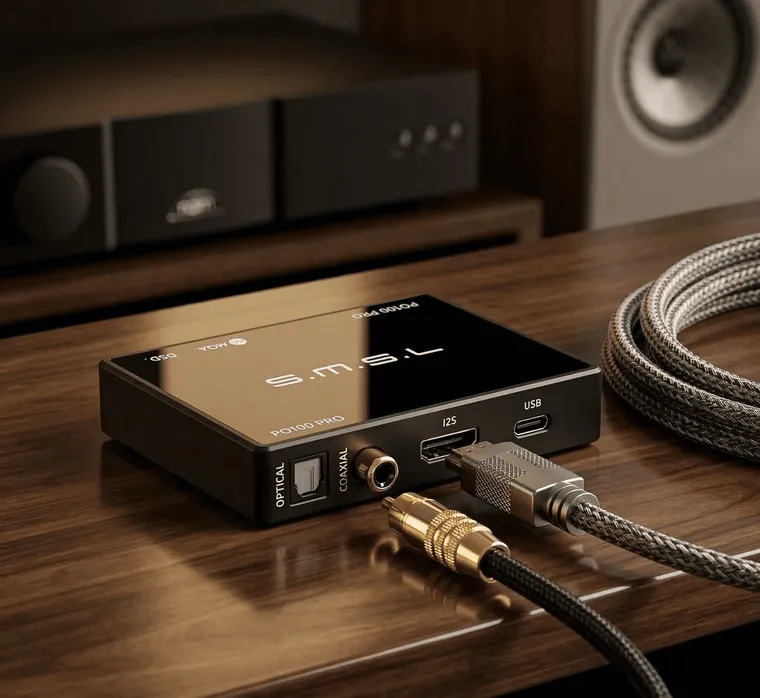
Can a $70 box improve a high-end audio system? Discover how the SMSL PO100 PRO DDC cleans USB noise to unlock better soundstage and clarity. Read the review!