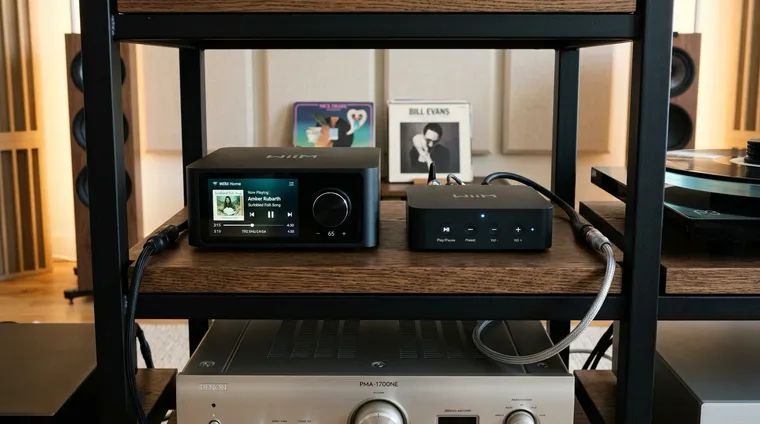
WiiM Pro Plus vs WiiM Ultra: Which One Actually Fits Your System?
WiiM Ultra vs WiiM Pro Plus, and WiiM Pro vs Pro Plus: DAC, ADC, remote, and price. I own the Ultra. It still has no AirPlay 2; the cheaper Pro Plus does.
DMP-A6 Gen 2 against the WiiM Ultra. The WiiM is the value king; the Eversolo is the nicer source. I run the WiiM and have not lived with the DMP-A6.
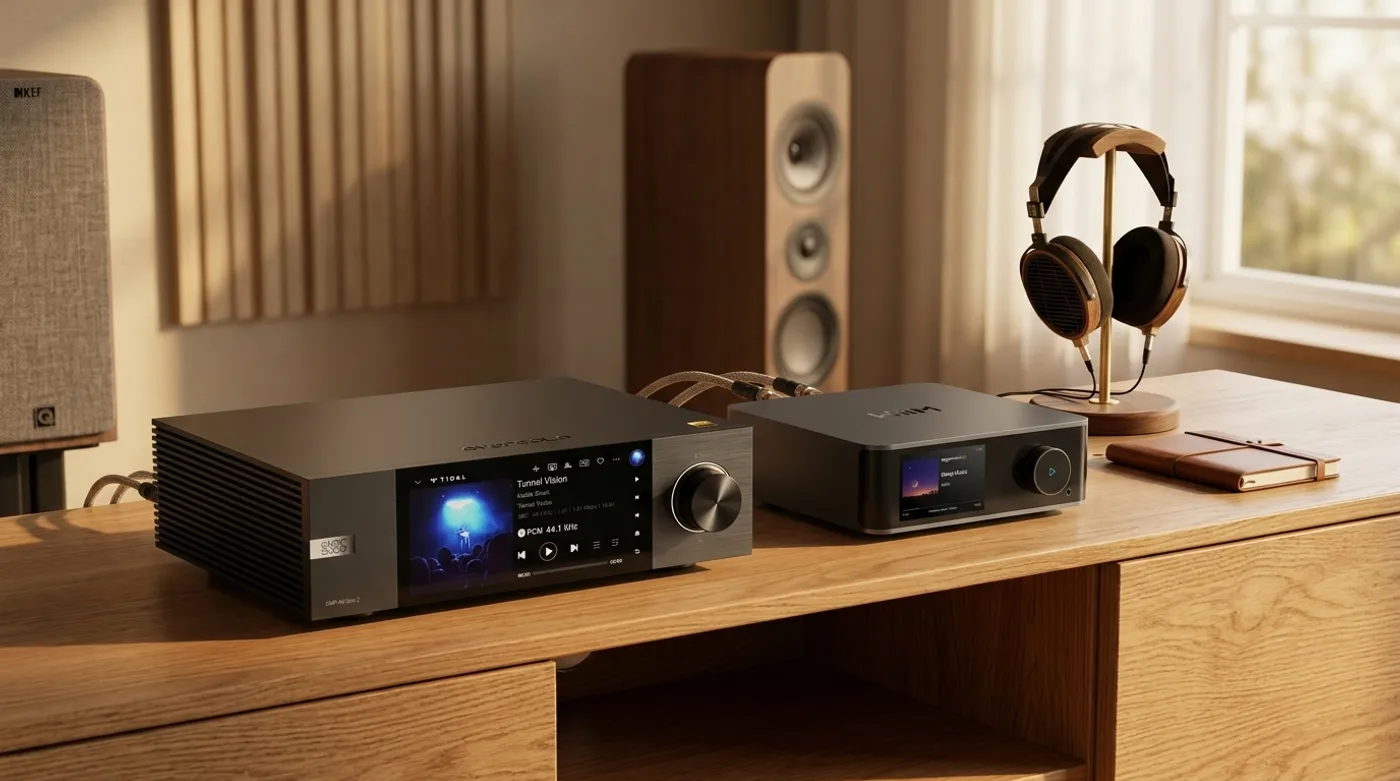
The short answer: The WiiM Ultra (around $329) and the Eversolo DMP-A6 (around $859) are both streamer, DAC, and preamp in one box, with no power amp, so both need a separate amp. The WiiM is the value king: room correction, a subwoofer output, a phono input, and a feature set that keeps growing. The Eversolo is the premium source: a larger screen, balanced XLR outputs, and a heavier, nicer build. If you want features per dollar, buy the WiiM and spend the difference elsewhere. If you want a premium source component and balanced outputs, the A6 earns its price.
I need to be upfront about something before we start: I own and run the WiiM Ultra. I have not lived with the Eversolo DMP-A6. So this is not a head-to-head where I swapped one for the other over a weekend and reported back. It is an honest cross-shop from someone who knows one of these boxes intimately and has done the homework on the other. Where I am speaking from experience, I will say so. Where I am reading the specs and the reputation, I will say that too. That is the only fair way to write this one.
Let me put the numbers where you can see them, because they frame everything else:
| WiiM Ultra | Eversolo DMP-A6 | |
|---|---|---|
| Price | ~$329 | ~$859 |
| What it is | Streamer, DAC, preamp | Streamer, DAC, preamp |
| Power amp | No (add your own) | No (add your own) |
| DAC | ESS ES9038Q2M | Dual ESS ES9038Q2M |
| Screen | 3.5-inch touchscreen | 6-inch touchscreen |
| Balanced XLR out | No | Yes |
| Room correction | Yes | Parametric EQ only |
| HDMI ARC (TV audio) | Yes | Yes |
| Subwoofer out / phono in | Yes | No |
| Build | Light, plastic and metal | Heavier, premium aluminum |
The Eversolo costs about two and a half times what the WiiM does. So the real question is not “which is better,” it is “is the Eversolo two and a half times better, or is it a couple hundred dollars of streamer and six hundred dollars of nicer object?” Spoiler, as always in this hobby: almost nothing is two and a half times better than a genuinely good cheaper thing. But that does not mean the extra money buys nothing.
This is the part I can speak to first-hand, because I use it every day.
For the money, the WiiM Ultra is close to absurd. Room correction is the headline. It measures your room and corrects the frequency response, and in a real room that does more for your sound than almost any component swap. The Eversolo gives you a parametric EQ, which is useful, but it is not the same as an automatic room-correction system. That is a genuine capability gap in the WiiM’s favor.
Then there is the feature density. A subwoofer output and a phono input for a turntable, neither of which the Eversolo has. Both boxes can take your TV’s audio over HDMI ARC, so that one is a wash. A 3.5-inch touchscreen that, while smaller than the Eversolo’s, does everything I need. And the WiiM keeps gaining features through firmware, which is the opposite of how most audio gear ages. For $329, it is doing the job of several boxes.
The honest ceiling: the WiiM’s analog output stage and build are good, not extraordinary. On a very revealing system you may sense that a more expensive source has a little more polish. But the gap is smaller than the price difference suggests, which is the whole point of the WiiM.
Here I am reading specs and reputation rather than speaking from my own rack, so take it as informed, not lived-in.
The DMP-A6 is the more serious object. The build is heavier and more premium, closer to a traditional high-end source component than the WiiM’s lighter chassis. The 6-inch touchscreen is genuinely lovely by all accounts, big enough to browse album art and manage a library without reaching for your phone, and the Android-based operating system supports a real ecosystem of streaming apps rather than a fixed set.
The spec that matters most to me is the balanced XLR outputs. The WiiM Ultra is RCA only. The A6 runs dual ES9038Q2M DAC chips in a fully balanced layout that feeds true XLR outputs, so if you run a balanced amplifier, or you need a longer interconnect run, that is a real, practical advantage, not just a badge. It is the clearest single reason to choose the Eversolo.
Where the WiiM claws value back is room correction and the connectivity extras (a subwoofer output and a phono input) that the A6 does not match. So this is not a simple “spend more, get more” ladder. The two boxes made different bets: the WiiM bet on features and room correction, the Eversolo bet on build, interface, and balanced analog outputs.
For most people building a system in 2026, the math favors the WiiM, and it is not because the Eversolo is bad. It is because a streamer’s job is to get the signal to your amp cleanly, the WiiM does that plus room correction for a third-ish of nothing, and the parts of the chain that move the sound most, speakers and the room, are where your extra $530 does more work. If you want the full WiiM rundown, it is in my WiiM Ultra review, and if you want the same value argument against a pricier British streamer, I made it in Cambridge CXN v2 vs WiiM Ultra.
The Eversolo is the nicer thing. The WiiM is the smarter buy. Both are true at once, and which one wins is really a question about where the rest of your money is going.
WiiM Ultra vs WiiM Pro Plus, and WiiM Pro vs Pro Plus: DAC, ADC, remote, and price. I own the Ultra. It still has no AirPlay 2; the cheaper Pro Plus does.
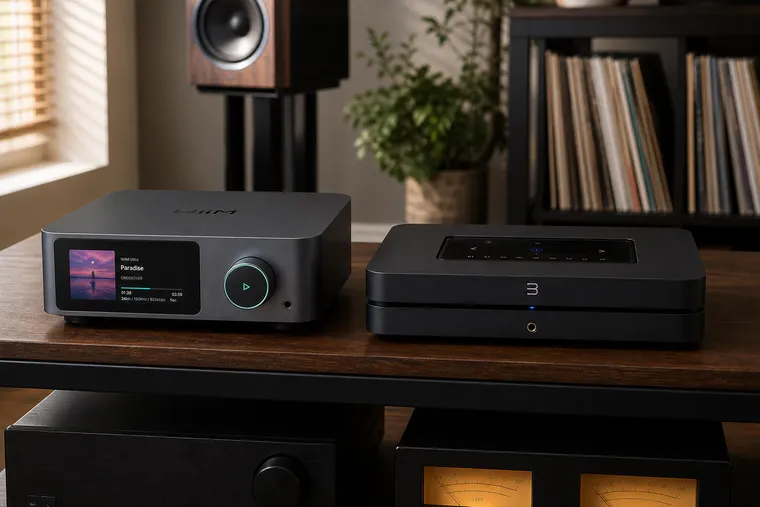
The Node costs $749, the Node Icon $1199, the WiiM Ultra $329. I own the Ultra. Here is what Bluesound's extra money actually buys, where the WiiM closes the gap, and who should still pay up.
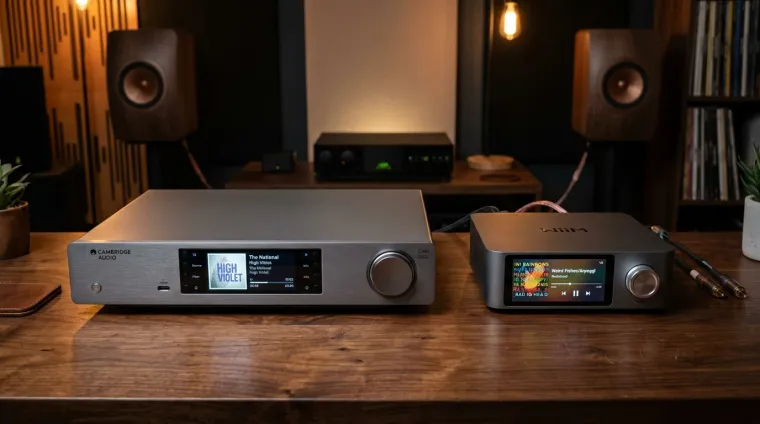
Shopping Cambridge CXN100 vs WiiM Ultra? The CXN100 and legacy CXN v2 cost about 3x the WiiM. Here is how they compare on sound, features, and value, and who should save the money.