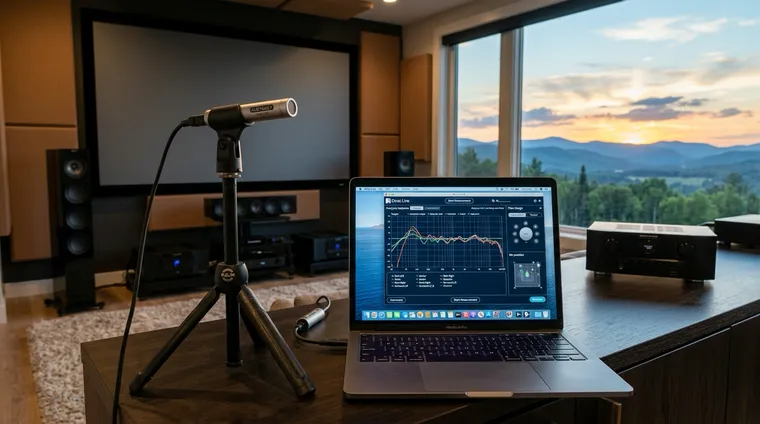
Audyssey vs Dirac Live: Is the Upgrade Worth $349?
Audyssey came free with your receiver. Dirac Live costs $259 to $349 on top. Here is what the money actually buys, which rooms need it, and when Audyssey XT32 is already enough.
ART is the first new idea in consumer room correction since mixed-phase filtering, and it is being sold with a word that does not describe it. Treatment removes energy from a room. ART relocates it. That distinction decides whether the $299 is worth spending in your room.

Dirac Live ART stands for Active Room Treatment, and treatment is the wrong word. I am not splitting hairs. It is the difference between what the technology does and what a buyer will assume it does.
Acoustic treatment removes energy from a room. A bass trap converts sound pressure into heat, and the energy is gone regardless of where you sit. ART does something else: it uses your other speakers to emit cancellation signals that null out room resonances at the positions where you put the measurement microphone. No energy leaves the room. It is moved.
That distinction runs through everything below, and it is the thing to hold onto when you decide whether $299 is worth spending in your room.
ART designates one primary loudspeaker and a set of support loudspeakers, models the room as a multiple-input multiple-output system, and optimizes all of them together so the combined result matches a target impulse response at the measured positions. That is straight from the patent, not a marketing summary: US9781510B2, assigned to Dirac Research, with a priority date of March 2012. The peer-reviewed basis is Brännmark and Ahlén in the Journal of the Audio Engineering Society, where support loudspeakers are described as improving the main speakers’ response “while suppressing the reverberation,” with a focus control parameter (JAES 63, 2015).
Two details matter more than the rest.
It works between roughly 20 and 150 Hz. Dirac’s own support documentation gives that range (Dirac helpdesk). ART is a bass technology. Everything the name implies about your room as a whole applies to less than three octaves at the very bottom.
The time-domain target is real. Dirac’s patent optimizes toward target impulse responses, not just a magnitude curve. Whatever else is true, that is a different objective from what multi-subwoofer optimization has historically pursued, and I will come back to why that matters.
I went into this expecting to find that ART was multi-subwoofer optimization with new branding. It is not, and the reason is worth understanding.
Magnitude EQ cannot control decay, full stop. To shorten how long a room mode rings, you have to modify the poles of the room’s transfer function, which a filter applied to the signal simply cannot do (Karjalainen, Antsalo and Mäkivirta, AES 23rd International Conference). So if a product claims to cut decay, the first question is whether it has a mechanism that could possibly do that. ART does.
The theoretical licence comes from a 1988 result usually called MINT, which showed that exact inversion of a room response is achievable when you have more loudspeakers than control points (Miyoshi and Kaneda). That is precisely ART’s configuration: several speakers, a handful of measurement positions. Within that arrangement, shortening measured decay at those points is not marketing. It is achievable.
So the honest verdict on the mechanism: multiple loudspeakers really can shorten measured decay at the control points. This is not just flattened frequency response with a new label on it.
Now the caveat that the marketing does not carry. This is cancellation, not absorption. The energy is still in the room. Performance away from the microphone positions is unconstrained by the optimization, which means the sweet spot may be smaller than the phrase “room treatment” suggests. And a bass trap keeps working when you move your chair.
Here is where it gets interesting, and it comes from the same body of research Dirac’s own work sits in.
The 2001 paper that first described controlling modal decay with secondary radiators cites evidence that the duration of a resonance’s decay is an unreliable indicator of whether that resonance is audible, and that audibility is governed more by frequency-domain characteristics. Related work found that at 50 Hz, decay times differing by up to two seconds were not reliably distinguishable (Mäkivirta, Antsalo, Karjalainen and Välimäki, AES 111th Convention).
Read that again in the context of a product sold on decay reduction. ART’s headline metric may not be the one that governs what you hear. That does not mean ART is inaudible; the same processing flattens magnitude response, and magnitude is what the literature says drives audibility. It means the improvement people report may be arriving through the ordinary door while the marketing points at the window.
The architecture is not new. The primary-plus-secondary-radiator concept for controlling modal decay was published in 2001, eleven years before Dirac’s patent priority and twenty-two years before ART shipped.
But ART’s objective really does differ from the multi-subwoofer work it gets compared to. Welti and Devantier’s foundational multi-sub paper runs eighteen pages, and it contains zero occurrences of the word “decay” and zero of “time domain” (JAES 54, 2006). Sound Field Management is explicitly about the spatial variance of amplitude response across seats. It is a magnitude method. ART is aiming at something the multi-sub literature was not aiming at.
The one prior approach that actually absorbs rather than cancels is the double bass array, where a rear array cancels the incoming plane wave with delay, and that demands architectural placement most people cannot manage.
So: ART is new as engineering, and not new as physics. Automated MIMO co-optimization across arbitrary speaker layouts, with a time-domain target and a focus control, is a real piece of work. The underlying idea that you can shorten modal decay with secondary radiators has been in the literature for two decades.
This is the finding that made me want to write this article, and I want to be careful about how I state it.
ART’s headline claim is reduced modal decay. To verify that claim you would need to do four things: measure decay with the magnitude response level-matched between conditions, measure at positions deliberately outside the calibration microphone pattern, report RT60 or T30 numerically alongside a stated analysis window, and compare ART against Bass Control rather than against no correction at all.
As far as I can find, nobody has done any of them.
What exists instead is hobbyist waterfall plots taken at the calibration position with no normalization, trade-press reviews that measured magnitude response and group delay rather than decay, and no peer-reviewed measurement of the shipping product at all. The Audioholics review most often cited as containing ART measurements measured frequency response and wavelets at the reference seat, compared ART against no correction rather than against Bass Control, and was conducted with StormAudio and Dirac engineers assisting the setup (Audioholics).
The specific problem is a confound that nobody has controlled for. ART necessarily flattens magnitude response at the same time it claims to shorten decay. A waterfall plot is computed from the same impulse response as the magnitude response and is drawn in absolute dB, so flattening a modal peak lowers the ridge automatically. A shorter-looking waterfall is exactly what you would see whether or not decay actually changed.
The forum record does not resolve this, and in places it undermines itself. One poster’s waterfalls used REW’s 300 ms default window, which is too short to show the effect being claimed (ASR). A member looking at another dataset pointed out that the “no correction” and “ART” waterfalls appeared identical and suspected mislabeled images, and never got an answer (AVS Forum). One user reports RT60 moving the wrong way and describes discarding that measurement in favour of the waterfall that agreed with expectations. And a capable AVS user started a thread specifically to validate ART with REW, was told plainly by another member that decay is the entire point and to run waterfall and RT60 before and after, and over two months posted only magnitude response (AVS Forum).
There is also a substantive dissent worth taking seriously: one poster reports that ART makes the initial pressure drop steeper while long-term decay time does not change much. That is a meaningfully different claim from Dirac’s, and it is testable.
The fair statement is that nobody has actually tested ART’s decay claim, and that is not the same as the claim being wrong. It may well be true. The evidence that would prove it just does not exist in public yet.
One honest caveat about my own reach: Audioholics and AVS Forum both block automated access, so some of the plots above were assessed through captions and posters’ own descriptions rather than by inspecting the axes myself. Read this as “no independent verification I could find,” not as a universal negative.
ART is a $299 add-on. It requires full-bandwidth Room Correction, and Bass Control as well if you use subwoofers, which stacks up quickly: Dirac’s bundle including all three is $799 (Dirac).
Device support as of July 2026, verified against Dirac’s own device matrix rather than press coverage:
| Supported | Not supported |
|---|---|
| StormAudio (all processors) | NAD (all 32 devices) |
| Denon AVR/AVC-A1H, A10H, X3800H, X3900H, X4800H, X6800H | Onkyo, Integra, Pioneer (0 of 11) |
| Marantz AV 10, AV 20, AV 30, CINEMA 30/40/50 | JBL Synthesis |
| AudioControl Hyperion APR-16 | Lexicon |
| miniDSP Tide16 | Emotiva |
| Monoprice Monolith HTP-1 | |
| Arcam AVA15 and AVP45 (AVA25/AVA35 coming) | |
| Dirac Live Processor for PC and Mac |
Get the timeline right, because several outlets have merged two separate events. ART shipped on StormAudio in 2023 as an exclusive, reached Denon and Marantz on 1 October 2025, and only arrived on PC and Mac via the renamed Dirac Live Processor on 30 June 2026. Those are different releases a year apart.
There is also a requirements contradiction worth flagging. Dirac’s helpdesk says the minimum configuration is “a stereo system with two speakers,” with subwoofers optional. Every unit that actually ships ART in the field is a high-end multichannel processor, and Audioholics reported that the gate for Denon and Marantz eligibility was four independent subwoofer outputs, though that language does not appear in Dirac’s own press release. The stereo-pair minimum is real only on the PC and Mac path, which is the one new option for two-channel listeners as of last month.
If you own an ART-capable processor and multiple subwoofers, and the licence is free or cheap on your hardware, it is worth running. Practitioner reports below 150 Hz are consistently positive, and the mechanism is sound.
If you are considering buying into the ecosystem specifically for ART, I would wait. You are paying $299 on top of $349 for correction and $299 for Bass Control, for a technology whose headline benefit nobody has independently measured, in a frequency band where the literature says decay may not be the thing you perceive anyway.
And one unexamined cost that nobody has published data on: using your main speakers as active absorbers demands real cone excursion at 20 to 50 Hz. There is no public data on the headroom or excursion penalty to the support speakers. One AVS user attributed an apparent ART improvement to aggressive support-level reduction of 11 to 15 dB, which if typical is a meaningful tradeoff hiding inside a feature sold as free improvement.
ART is the most interesting thing to happen to consumer room correction in a decade, and it is being sold with a word that oversells it. Both of those are true at once, and holding them together is the honest position until somebody runs the experiment.
If you have an ART-capable system and a measurement microphone, here is the test the entire category is missing:
That is four measurements and an afternoon, and it would settle a question that a lot of people have spent $299 on. If you run it, I would like to see the results, and I will link them here.
Audyssey came free with your receiver. Dirac Live costs $259 to $349 on top. Here is what the money actually buys, which rooms need it, and when Audyssey XT32 is already enough.
Spotify, Apple Music, Amazon, and YouTube Music all raised US prices in 2026, and Tidal is next. Here is what each service costs now, what you get for the money, and who the hikes make the worst buy.
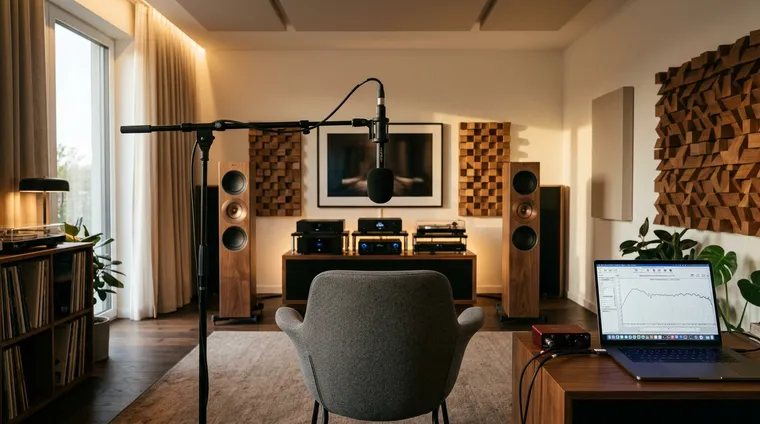
Dirac Live is not the only way to fix your room, and for a single-sub stereo system it may not be the smartest. Here is what every alternative costs, what it needs, and what the blind tests actually found.